
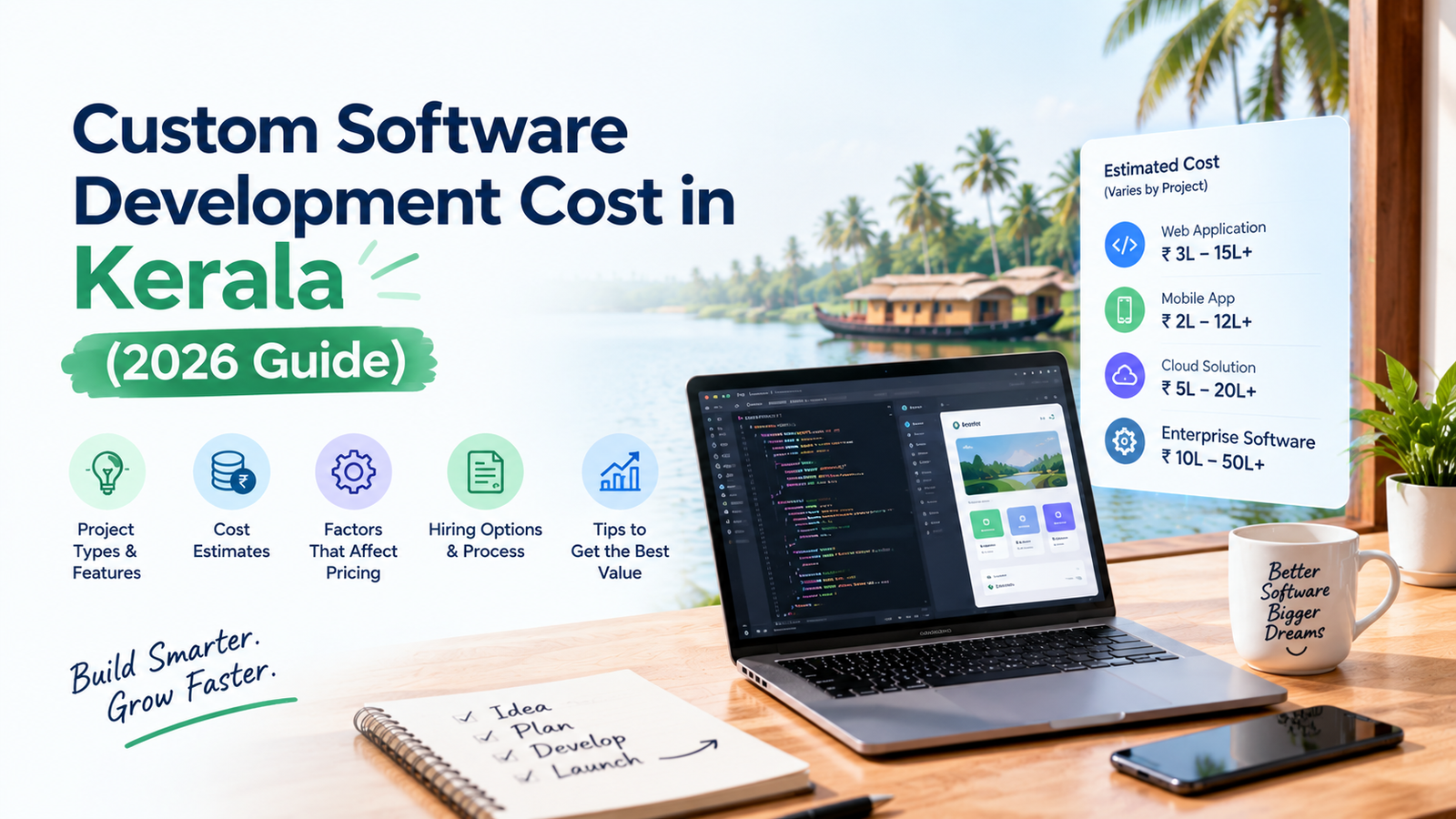
Custom Software Development Cost in Kerala (2026 Guide)
Custom software in Kerala can cost 1.5 to 30 lakh or more. See real price ranges, pricing models, hidden costs and 10 ways to spend less.
"How much will it cost?" is the first question every founder asks, and the last one most agencies answer clearly. Quotes range from a few lakhs to a few crores for what sounds like the same product, and nobody explains why. This guide fixes that. You will see what drives the price of custom software in Kerala, what typical budgets look like, which pricing model suits which project, and how to spend less without ending up with software you must rebuild in a year.
It is written for owners in Kerala and Calicut, and for Gulf-based business owners and NRIs weighing whether to build in India. Ranges below are indicative market figures, not a quotation, because real cost always depends on your scope.
Why custom software costs what it does
Custom software is paid for in people's time. Every feature is a few days of work from a designer, a developer and a tester. So the real question is never "what does an app cost?" but "how many weeks of skilled work does my idea need?" Four things move that number most:
Scope and features. A login, a dashboard and a report is a small build. Add roles and permissions, payments, notifications, integrations and an admin panel, and the effort multiplies. Design depth. A clean, standard interface costs far less than fully custom animation and branding. Integrations. Connecting to Tally, a payment gateway, WhatsApp or a government portal adds work, because each outside system behaves differently. Quality and security. Testing, backups, access control and documentation are invisible to users but decide whether the system survives real use.
Typical cost ranges in Kerala (2026)
Kerala teams generally cost a fraction of what comparable work costs in Dubai, Riyadh, London or the US, mostly because of lower overheads, not lower skill. Here is a realistic picture by project size:
Data Summary & Overview
| Feature | Specification | Status | Header |
|---|---|---|---|
| Project type | Examples | Indicative budget (INR) | Timeline |
| Small internal tool | Inventory tracker, quotation generator, staff attendance | 1.5 to 4 lakh | 3 to 6 weeks |
| Business system | Client portal, booking platform, CRM, school or clinic management | 4 to 12 lakh | 2 to 4 months |
| Complex platform | Multi-vendor marketplace, ERP-style system, fintech or logistics software | 12 to 30 lakh and above | 4 to 9 months |
| Ongoing support | Fixes, hosting, small features, monitoring | Usually 10 to 20 percent of build cost per year | Continuous |
Read these as starting points. Two projects with the same name can differ by a factor of three once integrations and edge cases are counted. A short scoping session is the only honest way to get a number you can trust.
Pricing models: which one fits you?
Fixed price. You agree on scope, cost and timeline before work starts. This suits small, well-defined projects where requirements will not shift. The risk: if you change your mind midway, each change is priced separately, and rushed estimates can lead to corners being cut.
Time and materials. You pay for the actual hours or sprints used. It suits products that will evolve as you learn from users. You keep flexibility, but you need an agency that reports progress openly, so costs never become a surprise.
Dedicated team (monthly retainer). A set group of developers works only on your product for a fixed monthly fee. It suits funded startups and companies with a long roadmap, and it often works out cheaper per feature once the team knows your business.
Phased delivery. Many smart owners combine the above: pay fixed price for a first version, then switch to monthly sprints. You see a working product early and avoid betting your whole budget on a plan written before anyone has used the software.
What the team looks like, and why it matters
A typical mid-size build involves a project manager, a UI designer, one or two developers, and a tester working part-time. A solo freelancer can be much cheaper for tiny jobs, but you carry the risk: if they fall ill or disappear, your project stops. A good agency spreads that risk and brings a repeatable process.
Ask who actually writes the code. Some companies sell on a polished pitch and subcontract the work, which makes quality and accountability harder to trace. CODO AI Innovations builds custom software with its own engineers, using PHP, Node.js and React, so the people you meet in the proposal stage are the people who build it.
Hidden costs most quotes forget
A low quotation can become an expensive project if these items are missing. Check each one before signing:
Hosting and servers. Cloud costs are monthly, and they grow with users. Third-party fees. Payment gateways, SMS, email and WhatsApp messages are billed by usage. Domain, SSL and licences. Small, but they renew every year. Content and data migration. Moving years of records from Excel or an old system is real work. Training and handover. Software your staff cannot use is wasted money. Source code ownership. Confirm in writing that the code, designs and database belong to you, not the agency.
Get a number you can plan around Tell us what you want to build. We will outline scope, timeline and a realistic budget range, with no obligation.
Building in Calicut and Kerala vs hiring abroad
For businesses in Calicut, Kochi, Trivandrum and across Kerala, working with a local team means in-person workshops when needed, easy site visits and no language gap. For Gulf businesses, a Kerala partner often delivers the same quality as a Dubai or Riyadh agency at a noticeably lower cost, with the added benefit of teams that already understand Gulf business habits through family and community ties.
Distance is rarely the problem people fear. Weekly demos and a shared task board keep everyone aligned, and the time difference between Kerala and the Gulf is only 1.5 to 2.5 hours, so you still get plenty of overlapping working time. We explain how that works in practice in our guide to time zone overlap between Kerala and the Gulf. If you run an early-stage company, our article on building software for GCC startups from Kerala covers the startup side in more detail.
Ten ways to reduce cost without hurting quality
-
Start with a minimum viable product. Launch the three features users truly need and add the rest after real feedback. It is the single biggest saving.
-
Write requirements down. A clear one-page brief prevents expensive rework. Vague ideas become long, billable discussions.
-
Use standard components. Login, payments and email rarely need to be built from zero. Proven tools are faster and safer.
-
Keep design simple at first. A clean layout converts well. Heavy custom animation can wait.
-
Decide early, change late less. Changing a database structure after launch costs far more than choosing it correctly in week one.
-
Automate repetitive work. If staff spend hours copying data between sheets, software pays for itself quickly. Our AI and automation services can remove those manual steps inside your new system.
-
Pick the right platform. A responsive web application often replaces the need for separate Android and iOS apps at launch. When you do need an app, our mobile application development team can build on top of the same backend.
-
Phase the roadmap. Split the project into releases of four to six weeks. You can pause or adjust after each one.
-
Assign one decision-maker. Committees slow projects, and slow projects cost money.
-
Beware of the lowest quote. The cheapest offer often leaves out testing, security or support. A fair price from a team that stays after launch is cheaper over two years than a bargain you must rebuild.
Do you need a full custom system, or just a website?
Not every business needs bespoke software. If you mainly need to present services, collect enquiries and rank on Google, a well-built site from our custom website development service costs far less than a full system. Choose custom software when your process is unique, when spreadsheets and off-the-shelf tools keep breaking down, or when software itself is your product. If a product launch is coming, branding and identity and digital marketing should be planned alongside the build, so users actually arrive on day one.
How to evaluate a software company before you pay
Look past the pitch. Browse their portfolio and ask what each client's problem was, not only what the screens look like. Request a milestone-based payment plan so you pay as work is delivered. Ask to speak with a past client, confirm who owns the source code, and check how they handle support after launch. If you want to estimate the effort in plain language first, try the tools on our premium tools page, then bring your notes to a scoping call. You can always return to the CODO AI Innovations homepage to see the full range of services.
What a good first conversation looks like
A trustworthy agency asks more questions than you do in the first meeting: who will use the software, what happens today, what a successful month looks like, and what must be ready by what date. You should leave with a clear scope outline, a list of assumptions and a phased price. If you leave with only a single number and no explanation, keep looking.
Ready to turn your idea into working software? Share your idea in a free scoping call and leave with a clear plan, timeline and budget range.
Frequently Asked Questions
Keep Reading
View All
Case Study: Albedo CALCT Project by CODO AI
See how CODO AI took the Albedo CALCT project from brief to launch: the goals, the build, the challenges we solved and the results. A real look at how we work.

Brand Identity Designer in Kerala: Packages & Cost (2026)
Thinking of hiring a brand identity designer in Kerala? See what a full identity package really includes, what drives the price, how branding differs for Kerala and Gulf audiences, and how to judge a portfolio before you pay.
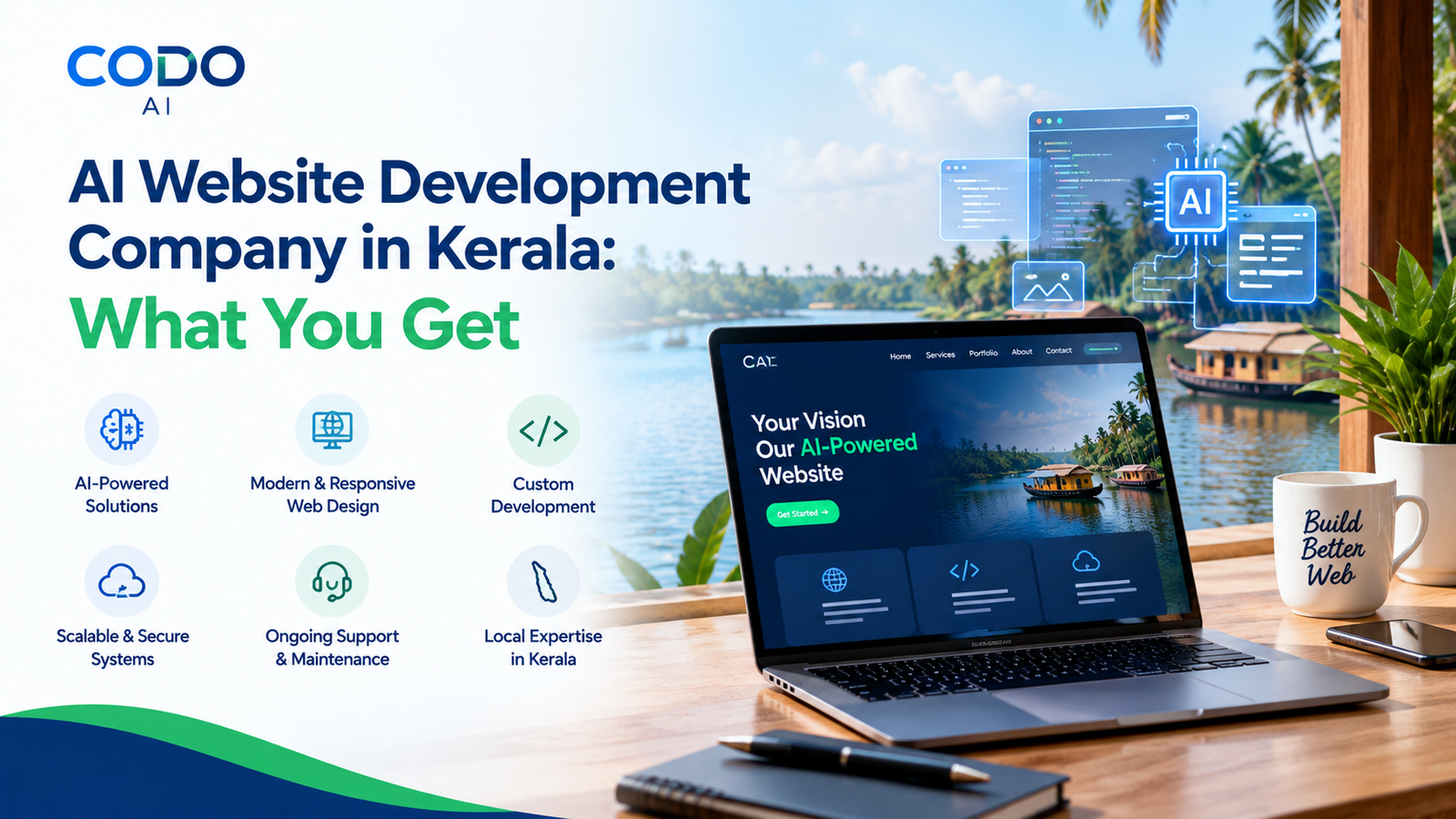
AI Website Development Company in Kerala: What You Get
What does an AI-powered website company in Kerala actually deliver? Features, chatbots, automation and costs explained for Kerala and GCC businesses.