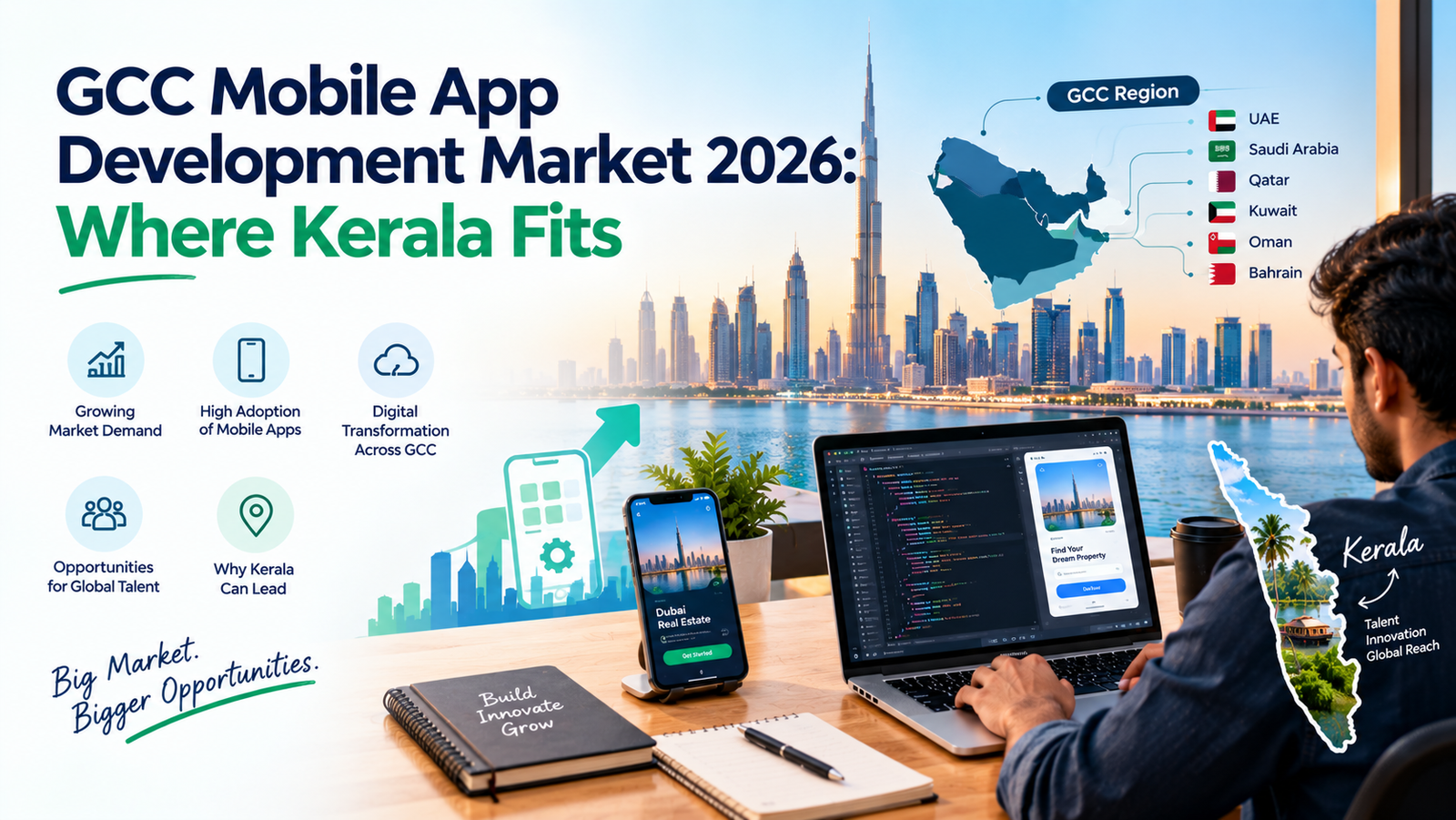
GCC Mobile App Development Market 2026: Where Kerala Fits
Gulf businesses are moving payments, services and shopping onto the phone. See where GCC mobile app demand is heading in 2026, what buyers expect, and why Kerala teams are winning Gulf projects on cost and time-zone overlap.
A customer in Dubai pays for coffee with a tap. A resident in Riyadh renews a document without leaving the sofa. A patient in Doha books a doctor in thirty seconds. In the Gulf, the phone is no longer a channel. It is the business.
That shift is why so many founders, retailers and enterprises across the UAE, Saudi Arabia, Qatar, Kuwait, Bahrain and Oman are asking the same two questions: where is demand heading, and who should build our app? This guide answers both, with real market data and an honest look at why Kerala teams are increasingly on the shortlist.
The short version: The GCC is among the most mobile-driven regions in the world, backed by fast 5G rollout, heavy public-sector digital spending and a booming cashless economy. Kerala development teams compete on strong engineering at sensible rates, plus working hours that overlap with the Gulf business day almost completely.
Why the GCC Is a Mobile-First Market
Three forces keep pushing Gulf businesses toward apps.
Connectivity is leading the region. According to GSMA's Mobile Economy MENA 2025 research, mobile technologies added around $350 billion to the MENA economy in 2024, roughly 5.7% of regional GDP, and the sector is forecast to reach about $470 billion by 2030. Mobile internet users in the region stood at 308 million in 2024 and are expected to reach 378 million by 2030. GSMA also expects 5G to climb from 7% of connections in 2024 to nearly half by the end of the decade, driven mainly by the Gulf, with the UAE, Kuwait and Qatar among the front-runners.
Governments are building digital-first services. Market analysts at Research and Markets describe the GCC as using mobile applications as a core delivery channel for smart government, tourism, digital identity, healthcare access, mobility and cashless payments, supported by strong public-sector investment. When the state moves to mobile, private businesses follow, because customers now expect the same convenience everywhere.
Money has gone digital. IMARC Group estimated the GCC mobile payment market at USD 52.6 billion in 2025 and projects it to reach USD 243.2 billion by 2034, an annual growth rate of about 18%. Every retailer, restaurant, clinic and logistics firm that wants a slice of that spending needs a polished mobile experience.
What the Numbers Do and Do Not Tell You
A word of caution before you build a business case. Global estimates for the mobile app market vary widely by methodology. Precedence Research projects growth from USD 330.61 billion in 2025 to USD 1,230.23 billion by 2035 (about 14% a year), while other firms use different baselines and definitions. We found no credible public source that isolates GCC app development services spend as its own figure, so treat anyone quoting a precise number with suspicion. The reliable signal is the direction: connectivity, payments and government digitisation are all rising together.
Where Demand Is Strongest
| Feature | Specification |
|---|---|
| Sector | What Gulf buyers want built |
| Retail and e-commerce | Shopping apps, loyalty, order tracking, WhatsApp ordering |
| Food and hospitality | Ordering, table booking, delivery and loyalty apps |
| Healthcare | Appointment booking, teleconsultation, patient portals |
| Real estate and mobility | Property search, lead capture, ride and fleet tools |
| Fintech and payments | Wallets, payment flows, KYC onboarding |
| Enterprise | Field-service, HR and operations apps for internal teams |
Many of these projects need more than an app. They need a backend, an admin dashboard and integrations with payment gateways and messaging, which is where custom software developmentbecomes part of the same build. Customers often discover your business through a website first, so a fastcustom website usually travels alongside the app.
What GCC Users Expect From an App in 2026
Statista's market outlook points to rising demand for localised apps that reflect cultural and language preferences. In practice, that translates into a clear checklist:
Arabic and English, with true right-to-left layout. Mirrored screens, not translated text pasted onto an English design. Local payment methods. Cards, wallets and cash-on-delivery options that match each country. WhatsApp in the loop. Gulf customers already live there, so order updates and support belong there too. Our guide to the WhatsApp Business API for Gulf businesses explains how. Speed and reliability. With 5G spreading, patience for slow screens is shrinking. Strong security and data protection. Each GCC country has its own data rules, so compliance has to be designed in from day one. A distinctive brand. A crowded app store rewards recognisable design, which is why many clients pair development with professional branding.
Budgets: What Actually Drives the Price
There is no honest one-size-fits-all price for a Gulf app. Cost moves with five things: the number of features, whether you need iOS and Android, how many integrations you add (payments, maps, messaging, ERP), the complexity of the admin panel, and the compliance requirements of your sector. A simple booking app and a multi-vendor marketplace sit at very different ends of the scale.
The smartest first step is a scoped estimate rather than a guess. Our breakdown of mobile app development cost walks through each cost driver, and the guide to custom software development cost in Keralacustom software development cost in Kerala covers the backend side that many first-time buyers forget to budget for.
Want a number you can plan around? Tell us what you want to build and who it is for. We will scope it and send a clear estimate.
Where Kerala Fits: Cost, Time Zone and Trust
Time-zone overlap is the quiet advantage. Kerala runs on India Standard Time, UTC+5:30. The UAE is 1.5 hours behind, and Saudi Arabia, Qatar and Kuwait are 2.5 hours behind. A Gulf team starting at 9 a.m. is talking to Kerala by 10:30 or 11:30 a.m., and the working day overlaps for the rest of the afternoon. Compare that with teams in Europe or the Americas, where a simple question can wait a full day. Our piece on the Kerala and Gulf time-zone overlap shows how this changes sprint speed.
Cost efficiency without cutting quality. Kerala has a deep pool of engineers and designers, and operating costs sit below Gulf agency rates. That lets clients fund better testing, better design or a longer roadmap with the same budget.
Familiarity with the Gulf. Kerala's long connection to the Gulf means many teams already understand the customers, the business culture and the pace. Founders get fewer misunderstandings, and less explaining. Startups weighing this route can read our take on why GCC startups partner with Kerala teams.
How to Choose the Right Development Partner
Ask to see shipped products, not just slide decks. Check live apps, store listings and update history. Confirm Arabic and RTL experience before you sign. Insist on a clear scope and milestones, with a demo at the end of every sprint. Check post-launch support. Apps need updates for every new OS release. Look for a team that can grow with you, across app, backend, website and automation. That last point matters more each year. Gulf businesses increasingly add AI to their apps, from smart chat support to automated lead handling, and an AI and automation partner under the same roof keeps the roadmap simple.
How CODO AI Innovations Can Help
CODO AI Innovations is a Kerala digital agency that builds mobile applications, websites, custom software, branding and AI automation for businesses in Kerala and across the GCC. We scope clearly, show progress every sprint and stay available after launch. If you are comparing partners, [talk to our team](https://codoai.in/contact) and bring your idea, even if it is only a sketch. Ready to build for the Gulf? Read the full cost guide, or send us your idea for a free estimate. Either way, you will leave with a clearer plan.
Frequently Asked Questions
Keep Reading
View All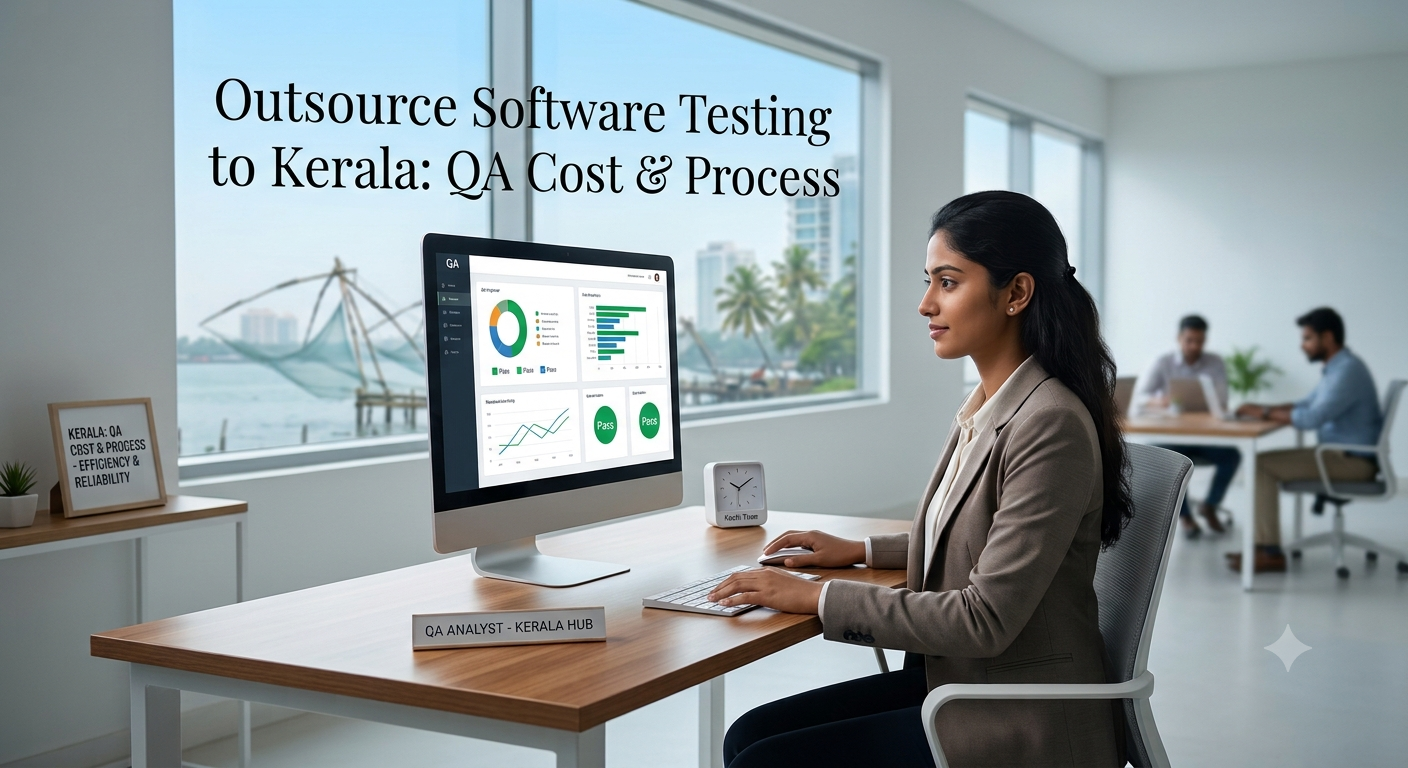
Outsource Software Testing to Kerala: QA Cost & Process
Planning to outsource QA? See what manual and automation testing cost in Kerala, how the process works, and which questions to ask vendors before you sign.
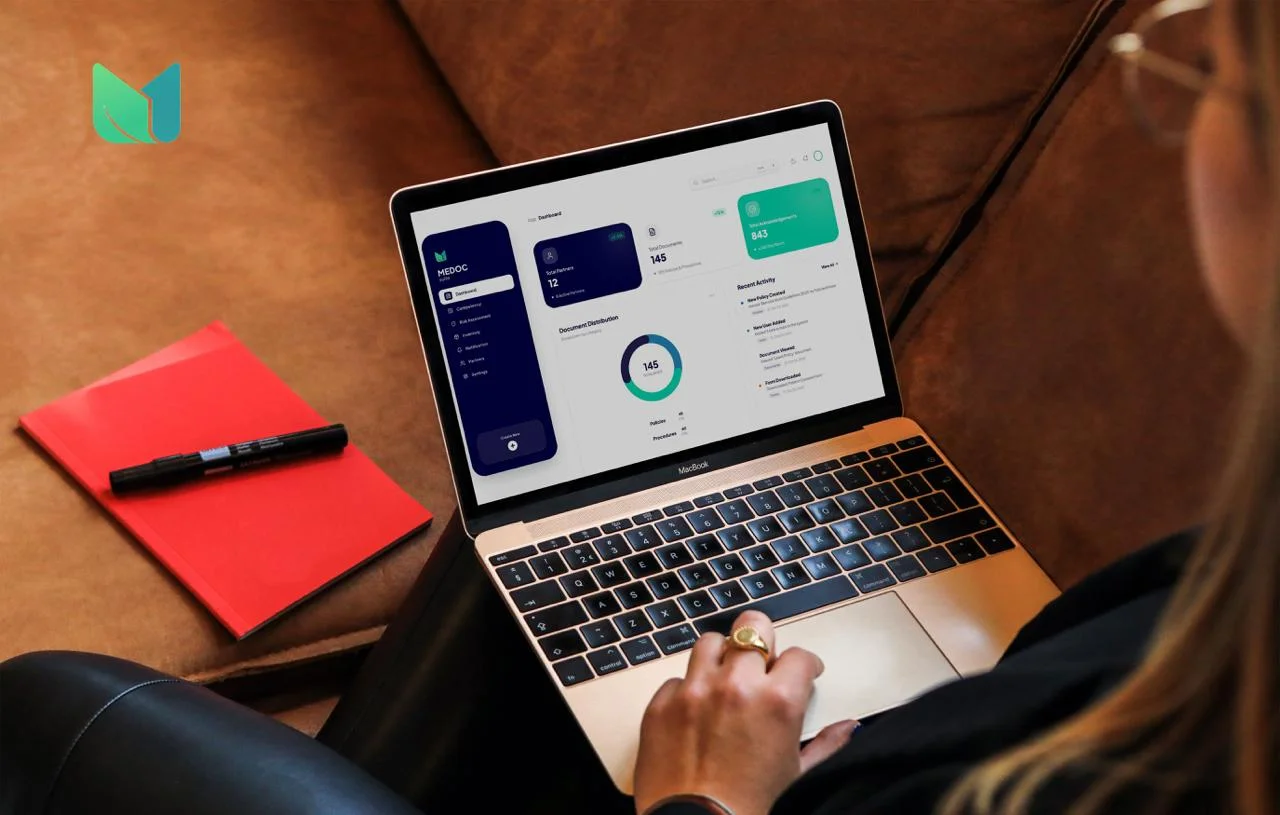
Case Study: Medoc Suite Platform by CODO AI
Scattered records, tricky scheduling and slow billing cost healthcare teams hours every week. See how CODO AI approached Medoc Suite, from discovery to launch, and what a single healthcare platform can change for your clinic.
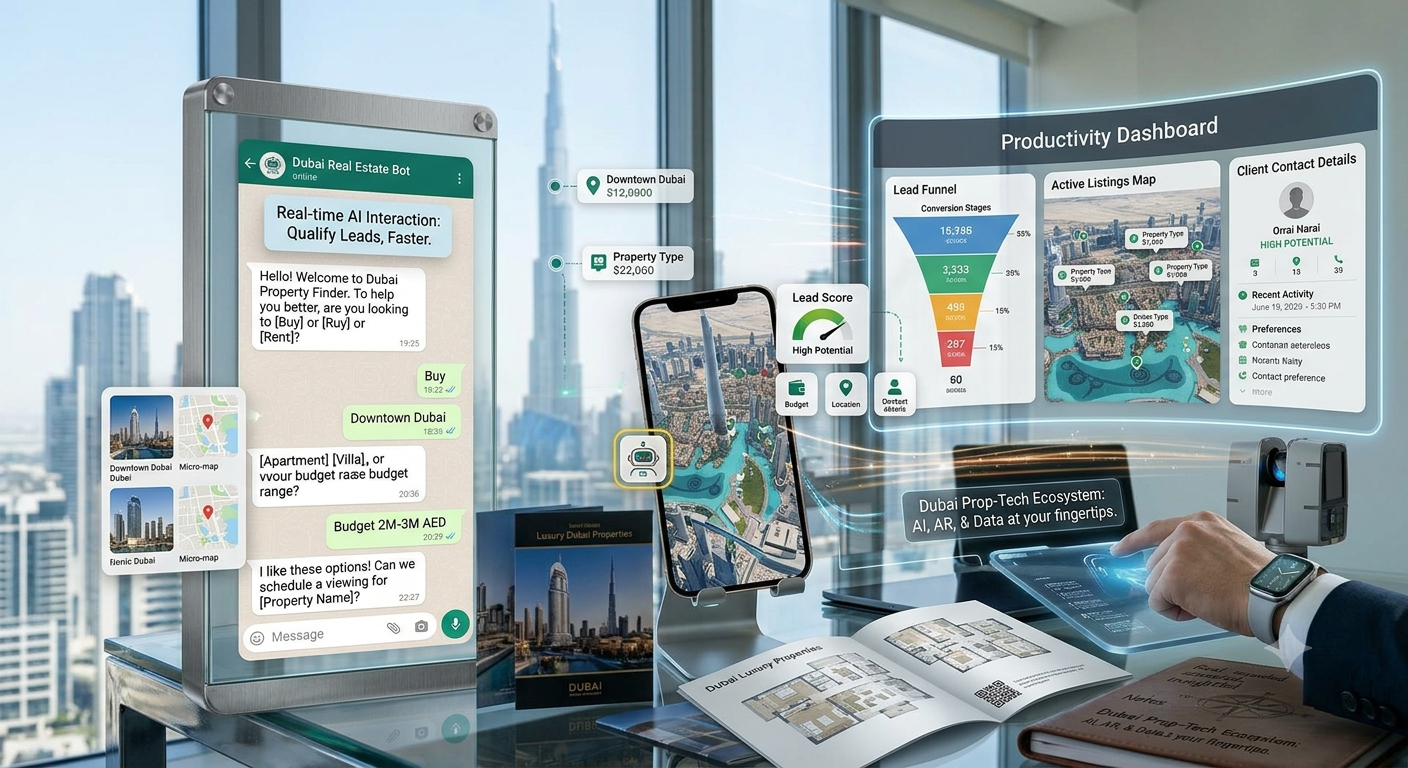
AI Chatbot for Dubai Real Estate: Qualify Leads on WhatsApp
Buyers message agents at midnight and book with whoever replies first. See how an AI WhatsApp chatbot answers enquiries, qualifies buyers and books viewings for Dubai real estate teams around the clock.