
Back to Journal
Website Designing
29 October 20265 min read
How Long Does a Website Take to Build? GCC Timeline Guide
J
Jubairiya KV
SEO Executive
Jubairiya KV
SEO Executive
From brief to launch: realistic website build timelines for GCC businesses by site type, plus what delays projects and how to avoid them.
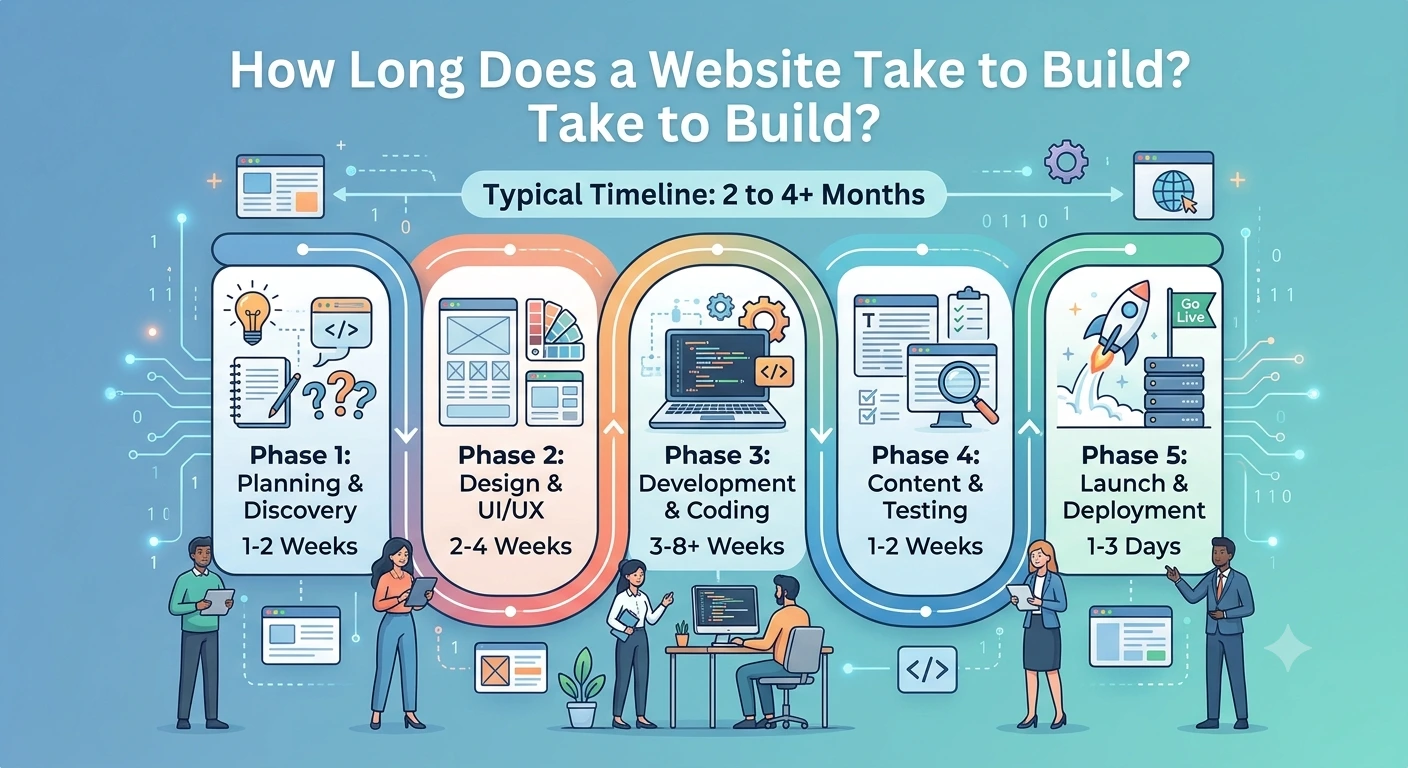
A typical business website takes 4 to 8 weeks from signed brief to launch. A simple company site can go live in 2 to 4 weeks, an ecommerce store usually needs 8 to 16 weeks, and a custom web application takes 3 to 6 months or more. That is the short answer. The honest answer is that the build itself is rarely the slow part. Most of the calendar time is spent waiting: for content, for feedback, for payment gateway approval and for sign-off. This guide shows where the time actually goes for GCC businesses, what causes delays, and how to plan a launch date you can trust.
These are typical ranges for a focused team working with a client who responds promptly. Treat them as planning figures, not guarantees, because scope decides everything.
| Site type | Typical timeline | What it usually includes |
|---|---|---|
| Brochure / company website | 2 to 4 weeks | 5 to 8 pages, contact form, basic SEO setup, mobile design |
| Business website with CMS | 4 to 8 weeks | 10 to 20 pages, blog, lead forms, analytics, WhatsApp integration |
| Bilingual English + Arabic site | Add 1 to 3 weeks | Right-to-left layout, translated content, language switcher |
| Ecommerce store | 8 to 16 weeks | Catalogue, payments, shipping rules, orders, product data import |
| Website redesign | 4 to 10 weeks | New design, content migration, redirect mapping to protect SEO |
| Custom web application | 3 to 6+ months | Logins, dashboards, integrations, testing in stages |
If you are still budgeting, our guides to ecommerce website development cost for GCC sellers and website redesign cost for an existing GCC business site show how scope affects price in the same way it affects time.
Knowing the phases helps you see which ones you control.
Most delayed projects are delayed by the same handful of causes. None of them is technical.
You cannot speed up a project by asking the developer to type faster. You can speed it up by removing waiting time. • Name one decision-maker. One person approves designs and collects feedback in a single message. • Prepare content early. Write or gather page text and photos during the design phase, not after development begins. • Fix the scope before design. Put features in a written list. Anything new goes on a Phase 2 list. • Apply for gateways and accounts immediately. Do not wait until the store is built. • Launch in phases. A strong 8-page site this month beats a perfect 30-page site in five months. Add the blog, extra languages and secondary features later. • Agree review windows. For example, 48 hours for each feedback round on both sides. Many GCC owners also choose to work with a Kerala-based team because the time-zone overlap is practical: the UAE is about 1.5 hours behind India and Saudi Arabia and Qatar about 2.5 hours behind, so daily calls fit inside shared working hours. We cover the wider picture in our article on why Kerala is becoming a preferred outsourcing hub for GCC startups.
Use this before you approve go-live. • All pages proofread in every language • Contact forms, WhatsApp buttons and phone links tested on mobile • Payment, shipping and order emails tested with real transactions (ecommerce) • Page titles, descriptions and image alt text added • Analytics and Search Console connected • Redirects set up from old URLs (redesigns) • SSL, backups and security settings active • Privacy policy, terms and business details published • Speed checked on mobile • A named person who will own updates after launch Launch is not the finish line. Sites need updates, backups and security patches. Plan for it from the start with a website maintenance plan for GCC businesses.
A Dubai-based service company wants a 10-page bilingual website with a lead form and WhatsApp integration. • Week 1: discovery, sitemap and scope sign-off • Weeks 2 to 3: design, with content being written in parallel • Weeks 4 to 6: development and Arabic layout • Week 7: testing, fixes and content review • Week 8: launch and handover If content arrives two weeks late, the launch moves to week 10. The work did not get harder, it simply started later. This is why a good plan lists your responsibilities as clearly as the developer's. See examples of delivered projects in our portfolio, or review our custom website development service to see what is included in each build.
The best way to answer "how long will my website take?" is to look at your actual scope. Share your pages, features and launch target, and the CODO AI Innovations team will send a phase-by-phase timeline with the dates we need content and approvals. Get a project timeline and we will reply within one working day.

What schools, coaching centres and training institutes need on their website: admissions flow, course pages, results and lead capture.
Should a Gulf SME buy Zoho or build a custom CRM? Compare cost, flexibility, integrations and when a Kerala-built system pays off.
How CODO AI built the G7 Holdings website: the brief, the design decisions, the build and what changed for the business.