
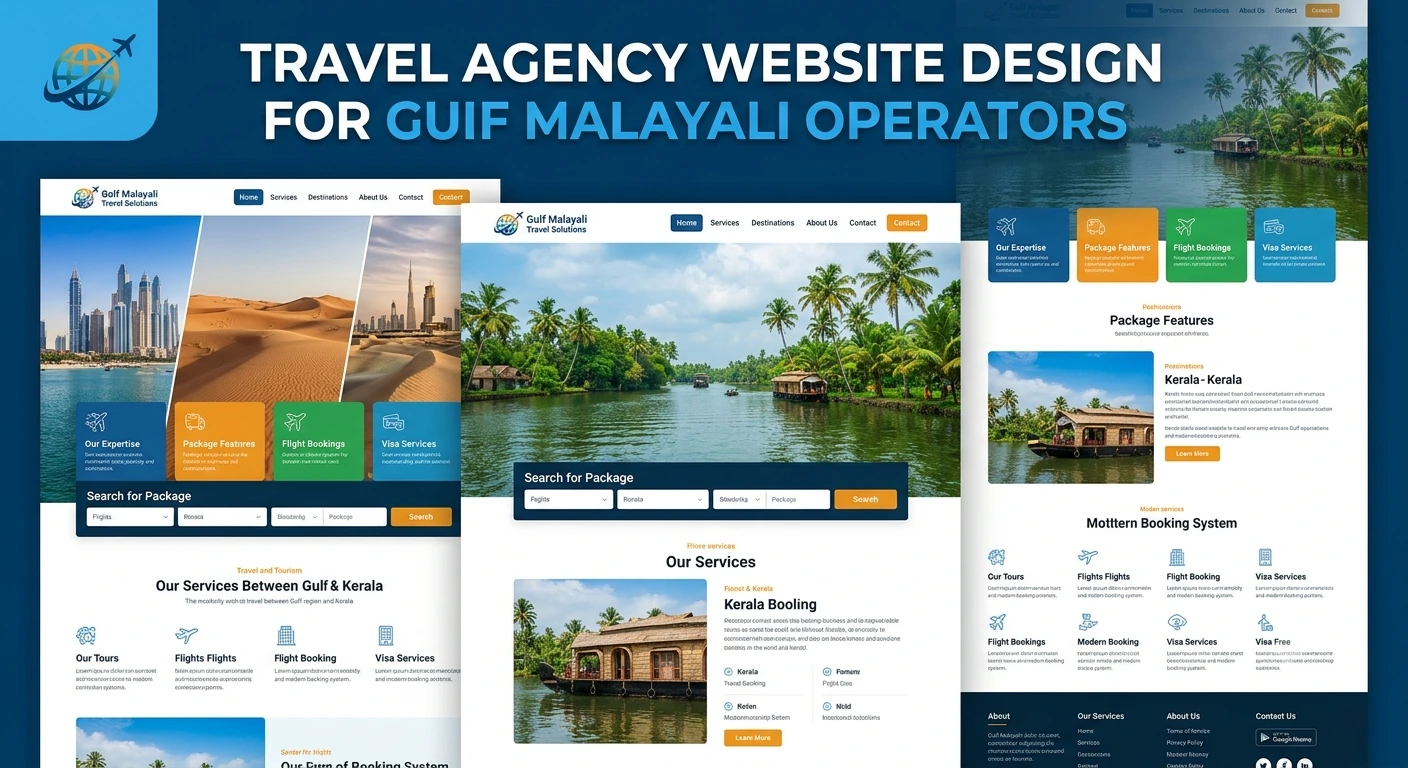
Travel Agency Website Design for Gulf Malayali Operators
Travel and tour operators serving Gulf Malayali customers need fast booking pages and WhatsApp enquiries. Key pages and features for a travel website.
If you run a travel agency, ticketing office or tour company in the Gulf, you already know who your customers are. A nurse in Riyadh booking a summer ticket home. A family in Sharjah planning a Kerala holiday with the grandparents. A group of friends in Doha who want a houseboat in Alleppey. Many of them find you through a cousin's recommendation, but almost all of them check your website or WhatsApp before they pay. That first check decides a lot. This guide covers what a travel agency website for Gulf Malayali customers needs: the pages, the features and the mistakes to avoid. It is written for owners and managers of travel agencies, tour operators and ticketing offices in the UAE, Saudi Arabia, Qatar and Kuwait.
Why a Gulf Malayali travel website is different
A generic travel template assumes a tourist in one country booking a trip to another. Your customers behave differently. • They are repeat travellers. Many go home every year, often at the same time, so seasonal demand around school holidays, Onam, Eid and Christmas matters more than one-off bookings. • They book for families and parents. One person often pays for tickets or a package for relatives in Kerala, so the buyer and the traveller may be different people. • They prefer a conversation. For fares, visas, baggage rules and package details, many customers would rather message than fill a long form. • They read in two languages. English works for most bookings, but Malayalam helps with parents, older relatives and first-generation customers. • They trust people. A recognisable team, a real office address and visible reviews carry a lot of weight. A website built around these habits will convert better than a global booking template. It also gives you a clear edge over agencies that only post offers on social media.
The essential pages for a travel agency website
Keep the structure simple. Every page should answer one question and lead to one action.
- Home page. Say who you serve and where, show your top services, and put a WhatsApp enquiry button above the fold.
- Services pages. Separate pages for air tickets, holiday packages, visa support and group tours, so each can rank on its own. Bundling everything into one page makes it harder for search engines and customers.
- Kerala tour package pages. One page per package or destination (for example backwaters, hill stations, family trips, honeymoon), each with an itinerary, inclusions, exclusions and a clear enquiry button. This is where a Kerala tour package website earns its traffic.
- Package comparison or catalogue page. A filterable list by duration, budget and trip type helps customers narrow down quickly on mobile.
- About and team page. Show real faces, your years of operation, your branch address and your licence or registration details where your market requires them.
- Reviews and trust page. Collect customer feedback, photos from trips and any partner or association logos.
- Contact page. Include a map, opening hours (with Gulf working days), phone, email and WhatsApp.
- Blog or travel guide. Articles such as "how to plan a Kerala trip with parents" bring in searchers who are not ready to book yet. If you already have a website that does not cover this structure, a redesign is often better than patching it. Our approach to existing sites follows the same logic we use for Gulf business websites in general: start with how customers behave, then design the pages.
Features that bring in bookings
- WhatsApp enquiry on every page For most Gulf Malayali travel customers, WhatsApp is the real booking channel. A floating WhatsApp button, a "Send my trip details" link and package pages that open a pre-filled message save the customer time and give you a warm lead. When your volume grows, you can also automate replies, send itineraries and hand over to a human agent. We covered what is possible in our guide to WhatsApp Business API automation for GCC businesses.
- A short, mobile-first enquiry form Most visitors will arrive on a phone, often on a mobile network. Ask only for what you need: name, phone or WhatsApp number, travel dates, number of travellers and destination. Longer forms lose people before they finish.
- Fast pages and light images Travel sites are image-heavy, and heavy images slow a page down. Compress photos, use modern formats and avoid autoplaying video on mobile. Speed is a booking issue as much as an SEO issue, because a customer who waits for a page to load will often go to the next agency.
- Clear package details Every package page should answer the same questions in the same order: duration, route, what is included, what is not, hotel category, transport and how to book. Customers compare several agencies at once, and the page that answers fastest tends to win the call.
- Online payment, where it makes sense Not every agency needs full online checkout on day one. Many start with enquiry and quote, then add a payment link or deposit option once the process is stable. If you do sell packages or ancillary products online, the planning questions are similar to those in our breakdown of ecommerce website development costs for GCC sellers, including payment gateways and order flow.
- Flight and hotel integrations If you want live fares or hotel inventory, you will need supplier APIs and a booking engine. That is a bigger project than a package catalogue, so decide early whether you are building an enquiry-led site or a full booking platform. Many agencies get the best return from a well-built enquiry site first.
- Bilingual content where it helps You do not need to translate every page. Start with the home page, key package pages and the contact page in Malayalam alongside English, then expand based on what customers ask for. Keep the language switch simple and visible.
- Trust signals Show your office address, licence details where relevant, customer reviews, trip photos and a named contact person. Our guide for Malayali retail and restaurant owners in Saudi Arabia makes the same point for a different industry: in this market, visible proof of a real, reachable business matters more than a flashy design.
Making the website visible in the Gulf
A good website only helps if customers can find it. For travel agencies, the most useful local signals are: • A complete Google Business Profile for each branch, with correct address, phone number, hours and photos, and a steady flow of genuine reviews. • Consistent business details (name, address, phone) across your website, Google profile and directories. • Dedicated service and destination pages so you can rank for searches like "Kerala tour packages from Dubai" instead of relying only on your home page. • Fresh content such as seasonal offers, travel tips and visa or baggage updates that you keep accurate. If you want help turning these into a steady stream of enquiries, our digital marketing and SEO services cover local SEO, Google Business Profile support and content planning for Gulf-facing businesses.
Common mistakes travel agency websites make
• Using a template with no Gulf context. Prices in the wrong currency, no WhatsApp option and generic tourist photos make the site feel foreign to your customers. • Hiding the contact details. If customers must hunt for a phone number, many will leave. • One page for everything. A single "Services" page cannot rank for tickets, packages and visas at the same time. • Outdated offers. An expired promotion damages trust faster than having none. Remove or update seasonal offers quickly. • Ignoring mobile. Test every page on a mid-range phone, not just a desktop screen. • No way to measure results. Track WhatsApp clicks, form submissions and calls so you know which pages bring bookings.
Choosing the right team to build it
You do not need a Gulf-based agency to build a Gulf-facing website. What you need is a team that understands your customers, communicates clearly across time zones and can show similar work. Our article on whether you need a UAE office to hire a Kerala agency explains how remote delivery works in practice, and our guide to choosing a Kerala web design agency for the Gulf lists the questions to ask before you sign. You can also look through our portfolio to see the kind of websites we build.
A simple launch plan
If you are starting from scratch, this order keeps the project manageable:
- Weeks 1-2: plan. Confirm your services, top packages, target countries and WhatsApp workflow.
- Weeks 2-4: design and content. Draft the page structure, package pages and key trust content.
- Weeks 4-6: build and test. Develop the site, test on mobile, and connect forms, WhatsApp and analytics.
- After launch: improve. Review which pages bring enquiries, add new package pages and refine your Google Business Profile. Timelines vary with the number of pages and integrations, so treat these as a starting point rather than a promise.
Frequently Asked Questions
Keep Reading
View All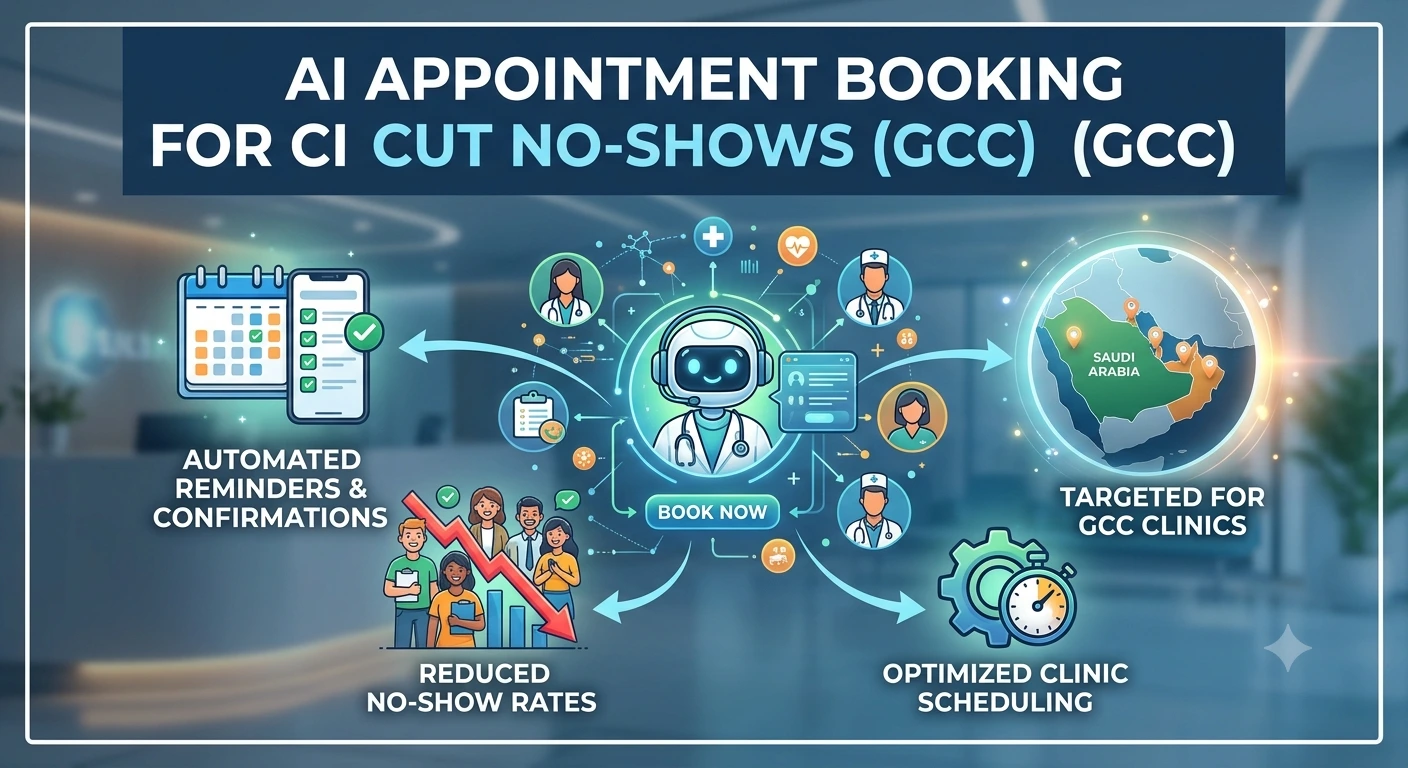
AI Appointment Booking for Clinics: Cut No-Shows (GCC)
Clinic owner in the UAE, Saudi or Qatar? See how AI booking and WhatsApp reminders help cut no-shows and front-desk work, and what setup involves.
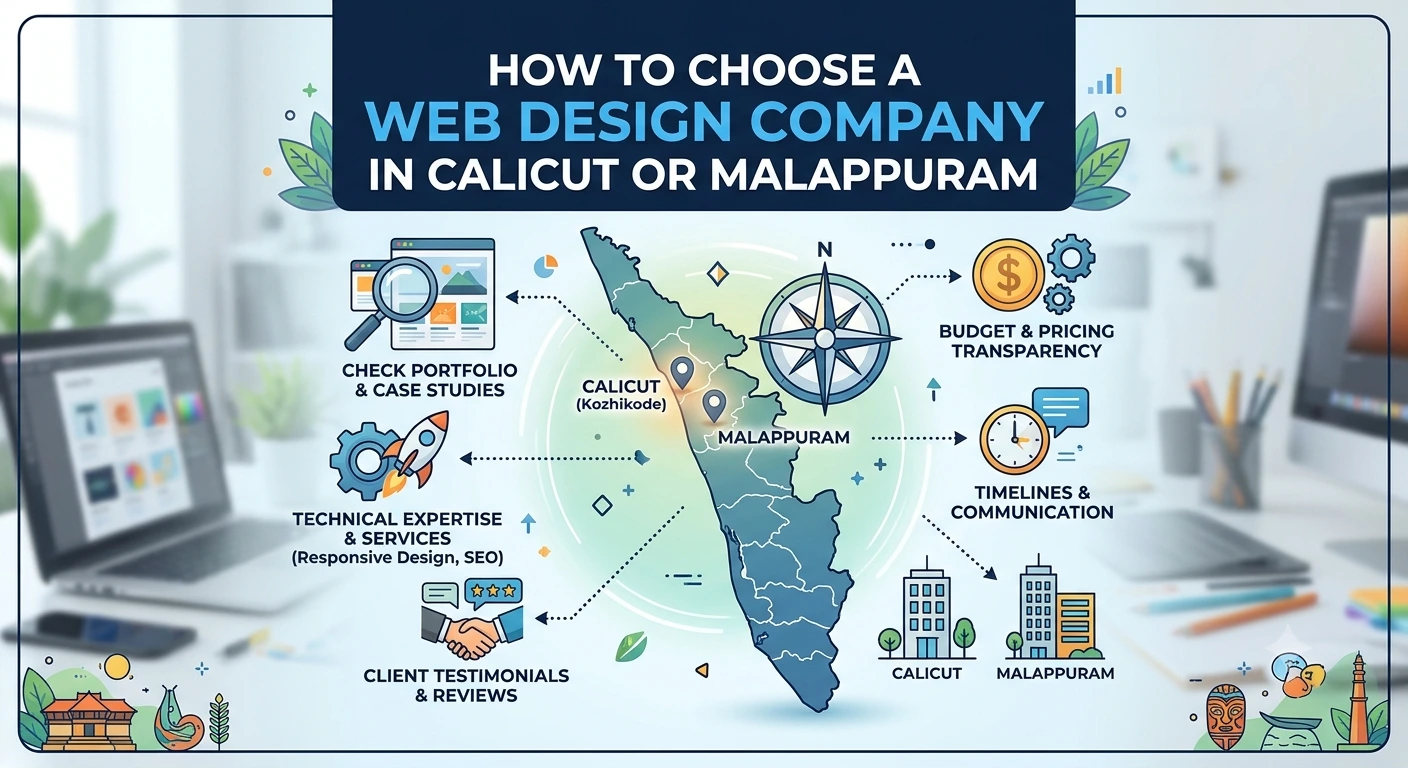
How to Choose a Web Design Company in Calicut or Malappuram - generate iamge for this blog
Choosing a web design or software company in Calicut or Malappuram? What to check, red flags, pricing and questions to ask before you sign.

Outsource Software Testing to Kerala: QA Cost & Process
Planning to outsource QA? See what manual and automation testing cost in Kerala, how the process works, and which questions to ask vendors before you sign.