
Jewellery & Gold Trading Websites in the GCC: What Converts
Live gold rates, secure checkout, real zoom — see the website features that actually convert GCC jewellery buyers, and view our jewellery-sector work.
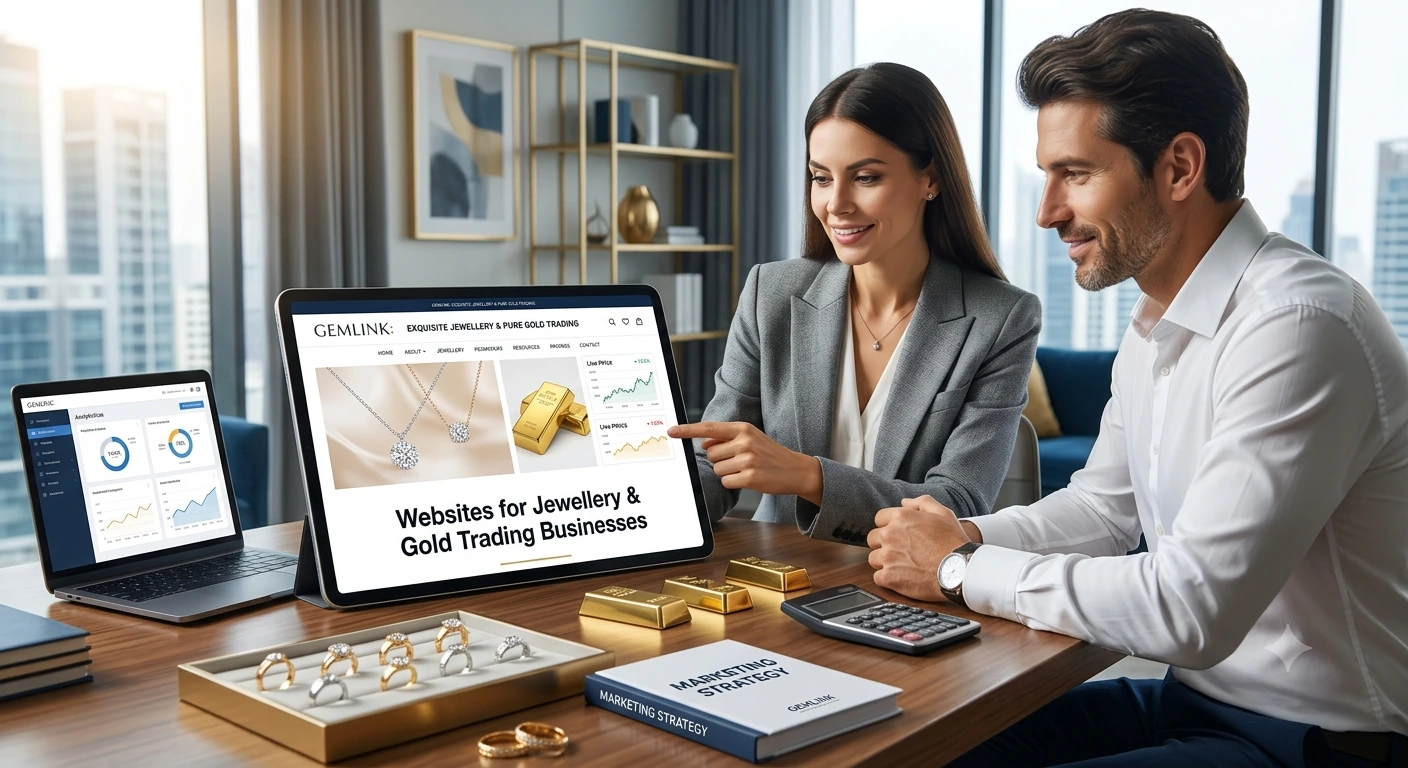
A gold trading or jewellery business is one of the few retail categories where the website has to do something most ecommerce sites never touch: display a price that changes by the hour, on a product a customer won't buy without seeing every angle first. Get either of those wrong — a stale gold-rate widget, or product photography that hides the very detail a buyer is trying to inspect — and the site actively costs the sale instead of closing it.
For Kerala- and Gulf-based jewellers and gold traders, this isn't a hypothetical. Malayali-owned jewellery businesses operate across the entire GCC — Dubai, Abu Dhabi, Doha, Riyadh, Manama, Kuwait City — often running multiple branches with a shared inventory and a customer base that moves fluidly between walking into a showroom and browsing on a phone first. A generic ecommerce template, the kind that works fine for clothing or electronics, simply doesn't handle what this category actually needs. Here's what does.
Why Jewellery & Gold Trading Websites Are a Different Build
Most product categories have a fixed price and a photo that tells the whole story. Jewellery has neither.
The price moves daily — sometimes hourly. Gold and diamond jewellery is typically priced as making charges plus the live metal rate, which shifts with international gold prices. A website that shows a static, manually-updated price is either wrong by the time a customer sees it, or requires someone on staff to update every listing every morning — neither of which scales past a handful of products.
The buying decision depends on inspecting detail a thumbnail can't show. A customer choosing a diamond necklace or a 22K gold bangle wants to see the setting, the finish, the clasp — the kind of detail that only shows up in genuine high-resolution zoom, not a slightly larger version of the same small photo.
Trust carries more weight than almost any other retail category. A customer is being asked to spend a significant amount on a single purchase, often without physically handling the product first if they're buying from abroad or across GCC borders. Every signal of legitimacy — hallmark certification, purity disclosure, secure checkout, real business information — either builds or breaks that trust in the first few seconds on the page.
The Features That Actually Move the Needle
-
Live gold rate integration, not a manually updated number. A jewellery site that pulls current gold and silver rates via API and reflects them automatically in product pricing removes the single biggest daily maintenance burden on staff — and removes the credibility risk of a customer catching a stale price. This is table-stakes for any serious jewellery ecommerce build today, not a premium add-on.
-
Weight-based and purity-based pricing shown transparently. Because gold jewellery pricing is a function of weight, purity (22K vs 18K vs 24K), and making charges, the product page needs to break this down clearly — not bury it in a single bottom-line number. Customers who understand exactly what they're paying for (metal value vs craftsmanship charge) convert at meaningfully higher rates than customers left to guess.
-
Real zoom and multi-angle photography — not a slightly bigger thumbnail. This is the single most under-invested feature on jewellery sites we've reviewed. A proper zoom function that lets a customer inspect stone-setting quality, engraving detail, and finish the way they would under a jeweller's loupe in-store does more for conversion than almost any other single feature on the page. 360-degree product views, where the budget allows, push this further still.
-
Secure, high-ticket-appropriate checkout. Jewellery purchases sit at a price point where a customer's hesitation at checkout is real and rational — this isn't a ₹500 impulse buy. Visible payment security badges, SSL, clear return/exchange policy, and (for GCC markets specifically) support for the payment methods customers there actually trust, are not decorative — they directly affect whether a cart converts or abandons.
-
Hallmark, certification, and purity disclosure front and center. BIS hallmarking (for India-sourced gold) and equivalent certification marks for diamonds and gemstones should be visible on the product page itself, not buried in a policy document. For a category built on trust, showing this proof at the point of decision — not after — measurably reduces cart abandonment.
-
Appointment booking for high-value or custom pieces. Not every jewellery purchase should end in an "add to cart" button. For bridal sets, custom designs, or high-value pieces, a website that offers a clean "book a private viewing" or consultation flow — rather than forcing every path through checkout — matches how customers actually want to buy at that price point.
-
WhatsApp catalog and direct inquiry integration. Across the GCC's Malayali and broader South Asian customer base, WhatsApp is often the preferred channel for a jewellery inquiry — sending a photo, asking about a specific weight or price, or requesting a hold on a piece before an in-store visit. A site that connects product pages directly to a WhatsApp inquiry, rather than routing everything through a generic contact form, closes far more of these conversations.
-
Multi-branch and multi-currency support. A GCC-based jewellery chain with branches across the UAE, Qatar, and Saudi Arabia needs a site architecture that can show branch-specific stock or pricing where relevant, and display prices in the customer's local currency (AED, QAR, SAR) rather than forcing an India-centric INR-only experience on a Gulf-based buyer.
Feature Comparison: Generic Ecommerce Template vs. Jewellery-Built Site
| Feature | Generic Ecommerce Template | Purpose-Built Jewellery Site |
|---|---|---|
| Pricing | Static, manually updated | Live gold-rate API, auto-updates by weight/purity |
| Product photography | Standard gallery, basic zoom | High-res multi-angle zoom, optional 360° view |
| Trust signals | Generic "secure checkout" badge | Hallmark/certification display on product page |
| High-value purchases | Same checkout flow for every item | Appointment/consultation flow for bridal & custom pieces |
| Customer inquiry | Generic contact form | Direct WhatsApp inquiry from product page |
| Multi-branch/GCC support | Single currency, single location | Multi-currency (AED/QAR/SAR), branch-aware inventory |
| Maintenance overhead | Staff manually updates prices daily | Automated, near-zero manual pricing upkeep |
Why This Matters More for GCC-Based Businesses Specifically
The Gulf's Malayali and broader Indian-origin jewellery trade is genuinely large — from long-established multi-branch chains to independent traders serving a loyal local customer base — and increasingly, these businesses are competing not just against the shop next door, but against a customer's ability to compare prices and designs online before ever walking in. A jewellery business that hasn't invested in a website matching how customers actually shop this category is handing that comparison advantage to a competitor who has.
There's also a compliance layer specific to the region: VAT display requirements in the UAE and Saudi Arabia, and clear purity/certification disclosure, aren't optional extras — they're part of operating credibly in these markets, and a well-built site should handle them as a baseline, not an afterthought.
📲 If you're running a jewellery or gold trading business anywhere in the GCC and want a clear read on what a proper build would look like for your specific branch setup and inventory, message us directly on WhatsApp — we're happy to walk through it, no pressure.
How CODO AI Innovations Builds for This Category
We've built ecommerce sites for Kerala and GCC-based sellers across a range of retail categories, and jewellery is one where the difference between a generic template and a purpose-built site shows up fastest in actual conversion numbers. Our approach for jewellery and gold trading clients typically includes:
Live gold/silver rate API integration tied directly into product pricing High-resolution, zoom-enabled product photography display, with 360° view as an option Secure, GCC-appropriate checkout and payment gateway integration WhatsApp Business catalog and inquiry integration built into product pages Multi-currency and multi-branch architecture for chains operating across more than one GCC country Hallmark/certification and purity disclosure built into the product template, not added as an afterthought
We'd also point out — and this is worth flagging directly — that a jewellery-specific project shown on our portfolio is the single strongest thing we can put in front of a prospective jewellery client. If we don't currently have a jewellery-sector case study live, this is worth prioritizing as a next build or, at minimum, a detailed write-up of relevant retail/ecommerce work we can point to in the meantime.
For a broader sense of what a professional build costs relative to a GCC business's budget, our ecommerce development cost guide breaks down realistic pricing bands, and our Custom Website Development and AI-Based Solutions & Automation service pages cover the technical build and rate-integration side respectively.
📲 Ready to see what a jewellery-sector build looks like for your business? Contact us for a free consultation, or message us on WhatsApp to talk through your branches, inventory, and current site — whether you're starting from scratch or fixing what's not converting today.