
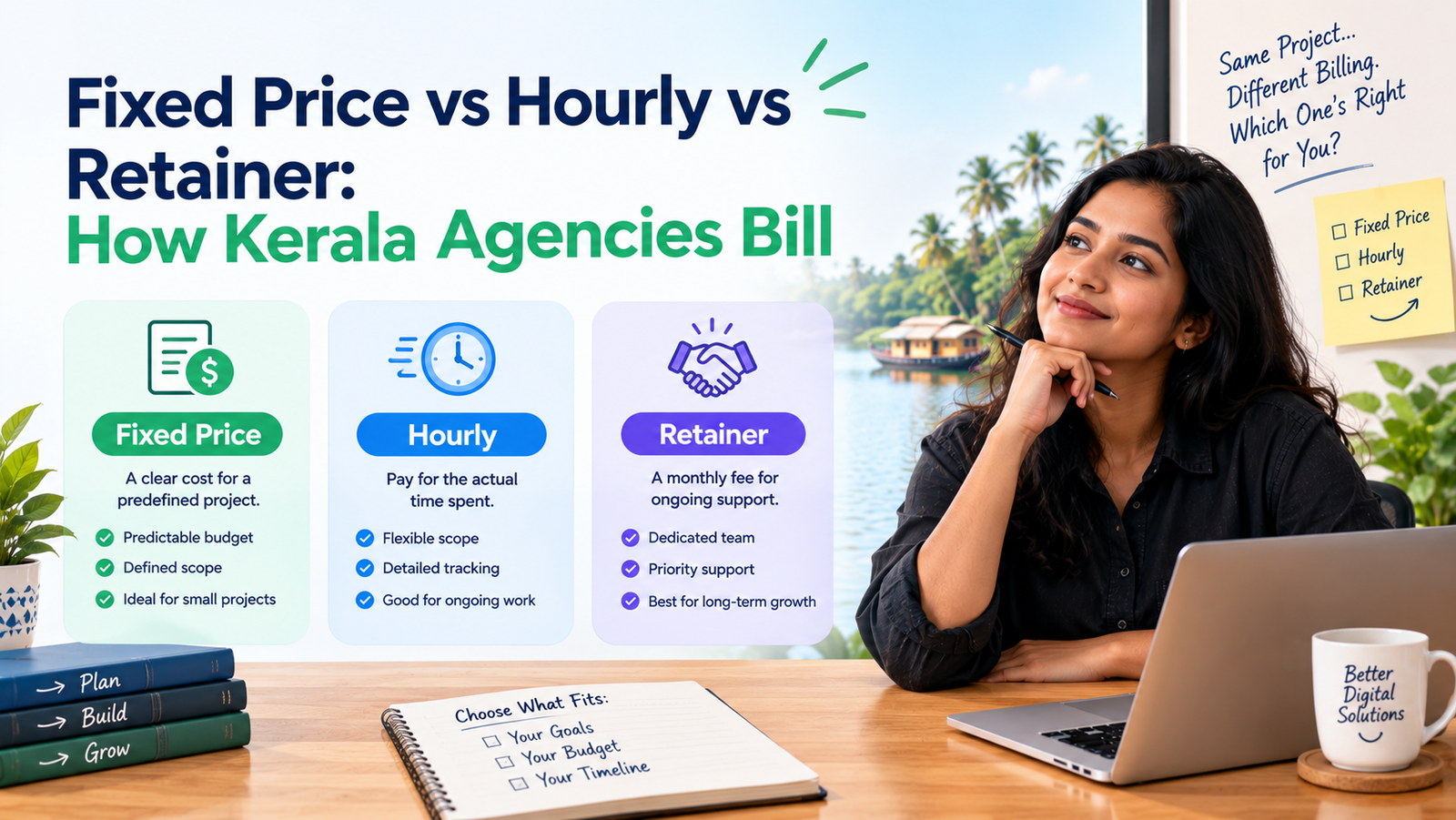
Fixed Price vs Hourly vs Retainer: How Kerala Agencies Bill
Fixed price, hourly or monthly retainer? Compare how Kerala agencies bill Gulf clients and which model suits a website, app or SEO project.
You have shortlisted a Kerala agency. The portfolio looks good, the team replied fast, and then the quote arrives. One agency says "fixed price". Another says "AED 90 per hour". A third wants a "monthly retainer". Same project, three completely different ways of paying. How do you know which one protects your money?
This guide explains how Kerala agencies really bill Gulf clients, where each model helps you, where it can hurt you, and which one fits a website, an app or an SEO project. By the end you will know exactly what to ask before you sign anything.
Short answer: Use fixed price when the scope is clear (a website, a logo, a redesign). Use hourly for small, unclear or experimental work. Use a retainer for ongoing work such as SEO, marketing, maintenance and continuous development. Most smart buyers combine two of them.
Why the Billing Model Matters More Than the Rate
Most buyers compare the headline number and miss the real question: who carries the risk? Every billing model decides who pays when something takes longer than expected, when requirements change, or when results are slow.
In a fixed-price deal, the agency carries most of the delivery risk. In an hourly deal, the client carries the time risk. In a retainer, both sides share risk, because you pay for capacity and expect steady output. Once you see billing as risk allocation, quotes become much easier to compare.
Model 1: Fixed Price
You agree on the deliverables, timeline and total cost before work begins. The invoice is usually split into milestones such as advance, design approval, development complete and launch.
Where it works best A new business website with a defined page list Logo and brand identity packages A website redesign with a clear brief An ecommerce store with a known set of features Advantages Predictable budget. You know the total before you start, which makes approvals easier inside your company. Focus on outcomes. You pay for a result, not for hours. Easy to compare. Three fixed quotes with the same scope can be lined up side by side. Watch out for Vague scope. "Website with modern design" is not a scope. If the quote does not list pages, features and revision rounds, expect disputes later. Change requests. Anything outside the written scope is billed extra. That is fair, but it should be spelled out. Cheap fixed quotes. An unusually low price often means corners will be cut or extras will appear later. If you are planning a new site, our custom website development service is quoted on a fixed-price basis once the scope is agreed.
Model 2: Hourly Billing
You pay for the actual time spent, tracked in a timesheet. Rates differ by role: a designer, a senior developer and a project manager rarely cost the same per hour.
Where it works best Small fixes, bug hunts and one-off tweaks Technical consulting and audits Early experiments where you cannot yet describe the final product Emergency support outside a normal contract Advantages Flexibility. You can change direction without renegotiating a contract. Fair for uncertain work. You are not paying a risk premium for unknowns. Low commitment. Good for testing an agency before a bigger project. Watch out for Open-ended cost. Without a cap, hours can grow quietly. Time zones. Gulf and Kerala hours differ by only a couple of hours, but confirm whether meetings count as billable time. Efficiency is not rewarded. A faster developer earns less, which is a structural weakness of hourly pricing. Protect yourself: Ask for a weekly timesheet, a monthly cap and written approval for any work above the cap.
Model 3: Monthly Retainer
You pay a fixed monthly fee for a defined amount of work or availability. The agency reserves capacity for you, so work starts without a new quote every time.
Where it works best SEO and content marketing, where results build over months Social media and digital marketing management Website maintenance, security and updates Continuous product development and AI automation improvements Advantages Priority access. Your team knows your business and responds faster. Compounding results. Marketing and SEO improve with steady effort, not one-off bursts. Smoother cash flow. A predictable monthly line item is easier to plan than irregular invoices. Watch out for Unclear deliverables. A retainer must list what you get each month: hours, pages, posts, reports. Long lock-ins. Prefer a 3-month start with a notice period instead of a 12-month commitment. No reporting. If you cannot see what was done, you are not buying a retainer, you are buying silence. For a look at how recurring marketing work is structured, read our guide to digital marketing package pricing in Kerala.
Which Model for Which Project?
A business website or redesign Go fixed price. The scope is easy to define and the result is a finished asset. If you already have a site and want a refresh, compare what to expect in our website redesign cost guide.
A mobile app or custom software Start with a paid discovery phase billed hourly or as a small fixed package, then move to fixed-price milestones for the build, and a retainer for improvements after launch. Our custom software development team usually works this way.
SEO and digital marketing Retainer, almost always. Search rankings do not appear on a delivery date. Treat it like a gym membership: the monthly effort is the product. Ask for a clear monthly report that shows work done and movement in rankings and enquiries.
AI automation and chatbots A hybrid works best: fixed price for the first automation, then a retainer for monitoring, tuning and new workflows. You can see what drives the cost in our AI automation cost guide, and explore the AI solutions and automation service for examples.
Logo and branding Fixed price with a defined number of concepts and revision rounds. See how packages are normally structured in our logo and branding package cost post, or browse the branding services.
Online stores Fixed price for the store build, then a retainer for catalogue updates, offers and growth. Budget factors are covered in our ecommerce website cost breakdown.
The Hybrid Approach Smart Gulf Buyers Use
The best deals rarely use a single model. A pattern that works well for UAE, Saudi and Qatar clients:
Discovery: a short, small paid phase to define scope and remove guesswork. Build: fixed price, paid in milestones tied to approved deliverables. Growth: a monthly retainer for SEO, maintenance and improvements. Extras: hourly for small requests outside the retainer. This keeps your launch budget predictable while giving you a long-term partner instead of a one-time vendor.
8 Questions to Ask Any Agency Before You Sign
What exactly is included, page by page or feature by feature? How many revision rounds are included? What counts as a change request, and how is it priced? What currency and payment method do you use, and who pays transfer fees? How are milestones tied to payment? Who owns the code, design files and domain after payment? What is the notice period if I want to stop a retainer? What reports will I receive, and how often? If an agency answers these clearly and in writing, that is a very good sign. You can see how we handle real projects in our Albedo CALCT project.
The Bottom Line
There is no single best billing model. There is only the best fit for your project's clarity, your budget rules and your growth plans. Pick fixed price for defined deliverables, hourly for uncertainty, and a retainer for ongoing results, then mix them where it makes sense. The agency that explains this openly, instead of pushing the model that suits only its own cash flow, is the one worth working with.
Get a Clear, Fixed-Price Quote for Your Project Share your idea, your market and your budget range. We will reply with a written scope, timeline and price, with no hidden extras.
Frequently Asked Questions
Keep Reading
View All
Supermarket & Grocery Websites with WhatsApp Ordering (GCC)
Gulf grocers can take orders on WhatsApp without a heavy platform. See the features, order flow and delivery setup that work for Malayali stores.
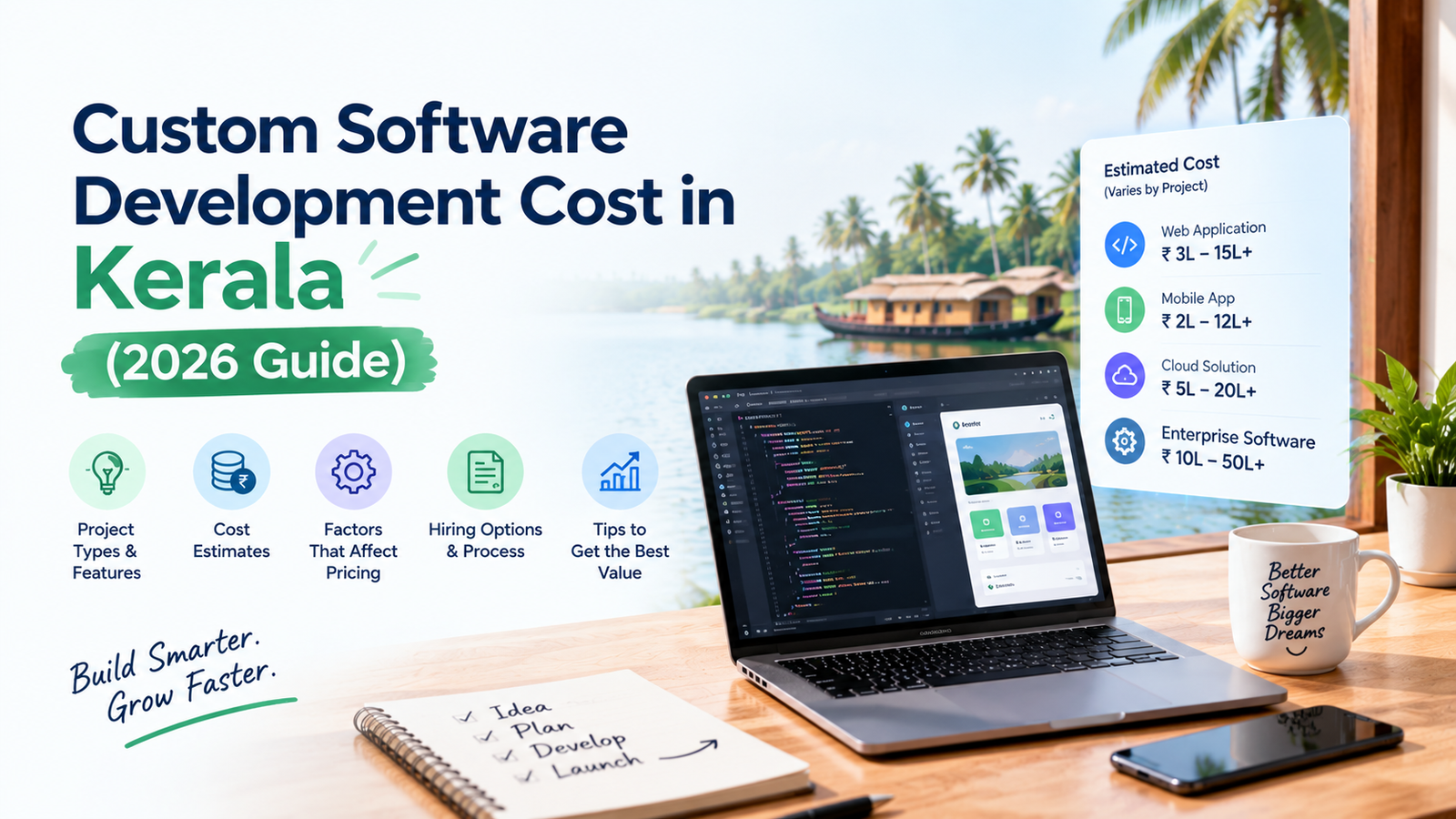
Custom Software Development Cost in Kerala (2026 Guide)
Custom software in Kerala can cost 1.5 to 30 lakh or more. See real price ranges, pricing models, hidden costs and 10 ways to spend less.
Case Study: Albedo CALCT Project by CODO AI
See how CODO AI took the Albedo CALCT project from brief to launch: the goals, the build, the challenges we solved and the results. A real look at how we work.