
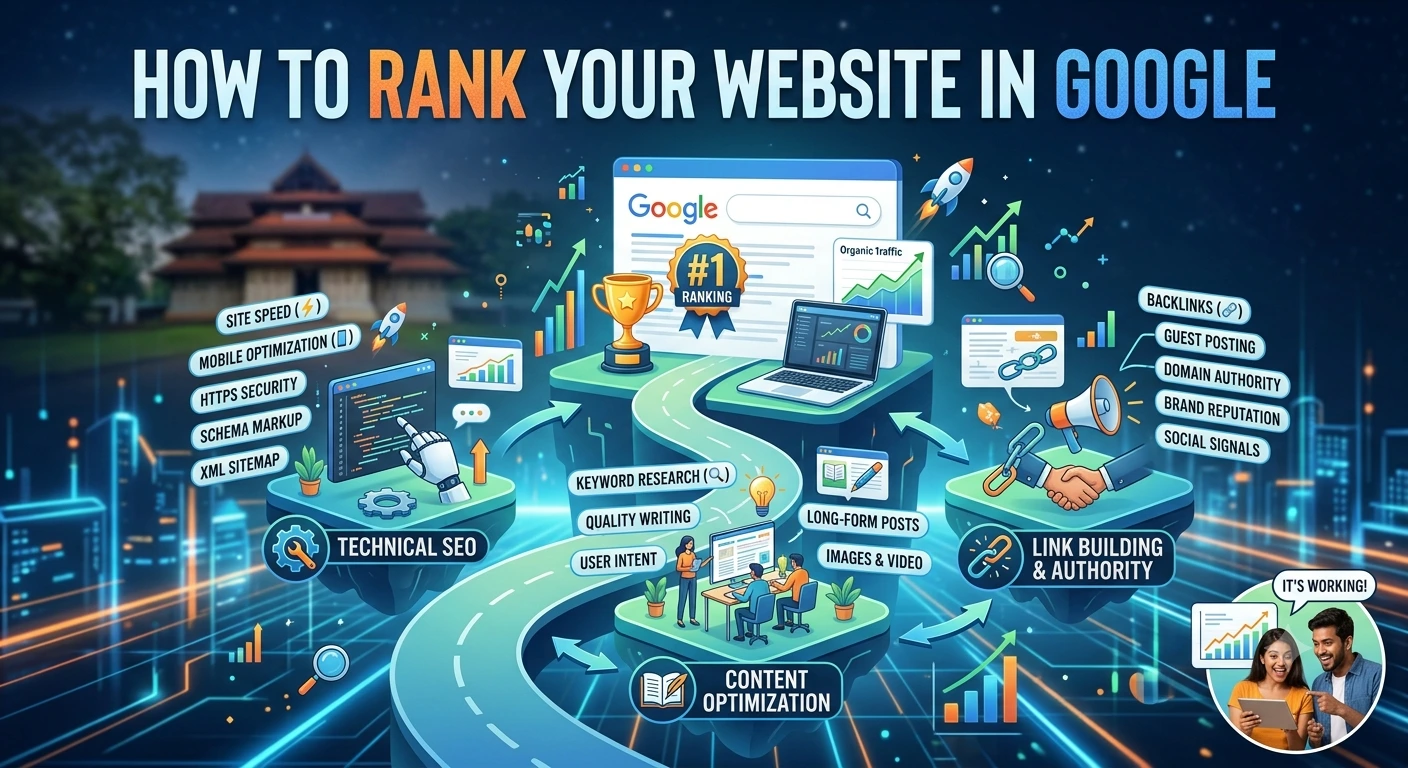
How to Rank Your Website in Google (2026 India Guide) | CODO AI Innovations
A practical, step-by-step guide to ranking your website on Google in India — technical SEO, content, local search, and the mistakes that slow businesses down.
Why Ranking on Google Actually Matters for Indian Businesses
There's a reason "how to rank on Google" is one of the most searched questions by business owners in India — organic search is still the single biggest source of free, high-intent traffic most businesses will ever get. A customer searching "best bakery in Kochi" or "affordable web design Kerala" isn't a cold lead. They're already looking for exactly what you offer, at the exact moment they're ready to act. Ranking on page one for the right terms means showing up in front of that customer for free, every single day, without paying for a click. The problem is that most guides either oversimplify ranking into a five-minute checklist, or bury it under so much technical jargon that business owners give up before they start. This guide sits in between: enough detail to actually move the needle, without requiring an engineering degree to follow it.
How Google Actually Decides Rankings
the tactics, it helps to understand what Google is actually optimizing for: showing searchers the most relevant, trustworthy, and usable result for their query. Every ranking factor — and there are hundreds — ultimately maps back to one of three questions Google is trying to answer about your page: Is this page relevant to what the person searched for? Is this page — and the site it's on — trustworthy and authoritative? Will the person actually have a good experience once they land here?Everything below exists to answer those three questions more convincingly than your competitors do.
Step 1: Get the Technical Foundation Right First
Content and links get most of the attention, but none of it matters if Google can't properly crawl, index, and render your site. Before anything else, confirm: Your site is mobile-friendly. Google indexes the mobile version of your site first, not the desktop version — critical in India, where the overwhelming majority of search traffic is mobile. Pages load fast. Every extra second of load time increases the chance a visitor leaves before the page even finishes rendering, and Google's Core Web Vitals directly factor page speed into rankings. Your site has a clean URL structure and working sitemap, submitted through Google Search Console, so Google can actually find and index every page you want ranked. There are no broken links or duplicate content issues silently confusing search engines about which version of a page to rank. This is genuinely the least glamorous part of SEO, and it's also where DIY sites lose the most ground before content even enters the picture. A site built on a solid technical foundation — the kind that comes from proper custom website development rather than a generic template — starts the ranking race without a handicap.
Step 2: Do Keyword Research the Way Indian Searchers Actually Search
Guessing keywords is the single most common mistake businesses make. Indian search behavior has patterns worth designing around specifically: City and locality-specific searches dominate for local businesses — "AI solutions company Kerala" behaves very differently in search intent than just "AI solutions company." Hinglish and regional-language queries are a growing share of voice search, especially on mobile. Price- and comparison-driven searches ("best," "affordable," "vs") are extremely common in a market where value-for-money is a major decision factor. Use free tools like Google Keyword Planner, Google Search Console (once you have some traffic), and even Google's own "People also ask" and autocomplete suggestions to see how people actually phrase their searches — not how you'd phrase them internally as a business owner.
Step 3: Write Content That Actually Matches Search Intent
Ranking isn't about stuffing a keyword onto a page — it's about a page genuinely being the best answer to what someone typed into Google. For every important page or blog post, ask: what is the person searching this term actually trying to accomplish? A search for "how to build a website for free in India" wants a guide, not a sales pitch. A search for "custom website development company Kerala" wants a service page with clear pricing signals and proof of work, not a 2,000-word essay. Structure content so Google — and readers — can quickly find what they need: A clear, descriptive title tag and meta description that match the actual search intent. Logical heading structure (H1, H2, H3) that breaks content into scannable sections. Internal links connecting related pages, which helps both users and Google understand how your site's content fits together — and helps distribute ranking authority across pages that deserve it. Original, specific content — generic, templated copy that reads like every competitor's page is exactly what Google's helpful-content systems are designed to push down.
Step 4: Build Authority Through Backlinks and Local Signals
Content and technical health get you eligible to rank. Authority signals are what actually push you up against competitors targeting the same keywords. In practice, this means: Backlinks from relevant, trustworthy sites — guest posts, local business directories, press mentions, and partnerships all count. Quality matters far more than quantity; ten relevant links outweigh a hundred spammy ones. A complete, accurate Google Business Profile, critical for any business with a local or regional presence in India — this is what powers Google Maps results and the local three-pack that appears above organic results for local searches. Consistent business name, address, and phone details (NAP) across every directory and listing your business appears in — inconsistency quietly undermines local trust signals. This is the layer where most solo business owners run out of time, since it requires ongoing outreach and monitoring rather than a one-time setup. It's also where a structured approach — the kind covered under proper digital marketing and SEO services — tends to outperform sporadic, DIY link-building.
Step 5: Don't Ignore User Experience Signals
Google increasingly rewards sites that keep visitors engaged rather than bouncing straight back to search results. A page that ranks well but has a high bounce rate and low time-on-page sends a signal that it didn't actually satisfy the search — and rankings tend to slip in response. Practical fixes: Make navigation intuitive — a confused visitor leaves fast. Use clear visual hierarchy so the most important information isn't buried. Ensure forms, buttons, and calls-to-action actually work on mobile, not just desktop. Keep a consistent, professional look across pages — a fragmented visual identity quietly erodes trust the same way a broken link does, which is part of why brand identity design and SEO performance are more connected than most businesses assume.
Step 6: Prioritize Local SEO if You Serve a Specific Region
For most Indian small and mid-sized businesses, "ranking on Google" really means "ranking for local search" — and that's a distinct discipline from general SEO: Claim and fully optimize your Google Business Profile with accurate categories, photos, and regularly posted updates. Collect genuine customer reviews and respond to them — review volume and recency are direct local ranking factors. Create location-specific content if you serve multiple cities or regions, rather than one generic page trying to rank everywhere at once. Get listed on relevant local directories and industry-specific listing sites.
Common Mistakes That Quietly Kill Rankings in India
- Chasing too many keywords on one page, diluting relevance instead of building it.
- Ignoring mobile performance while optimizing primarily for desktop.
- Buying cheap backlinks from low-quality, unrelated sites — a shortcut that actively damages rankings under Google's current systems.
- Publishing content once and never updating it, while competitors keep refreshing theirs.
- Skipping analytics — without Google Search Console and Analytics set up from day one, there's no way to know what's actually working.
How Long Does It Actually Take to Rank?
The honest answer: it depends on competition, but plan for months, not weeks. A brand-new site in a low-competition local niche might see meaningful movement in 8–12 weeks. A competitive national keyword can realistically take 6–12 months of sustained work to break into page one. Anyone promising guaranteed rankings in days is either exaggerating or using tactics that risk a future penalty.
When DIY SEO Stops Being Enough
Everything above is genuinely achievable without outside help — for a while. The point where most businesses hit a ceiling is when SEO competes for time with actually running the business, or when technical issues appear that go beyond a checklist fix. This is also where tools built around AI-driven search and automation are starting to change what "SEO work" even looks like — from keyword research to content optimization increasingly assisted by AI systems built for exactly this. If you're building these skills yourself rather than outsourcing them, CODO Academy runs training that covers modern SEO and digital marketing fundamentals hands-on. Ranking on Google in India isn't one trick — it's a combination of technical health, content that genuinely answers what people are searching, authority signals built over time, and a user experience that keeps visitors on the page once they land. Start with the technical foundation, build content around real search intent, and treat local SEO as its own discipline if you serve a specific region — the rest compounds from there.
Frequently Asked Questions
Keep Reading
View All
Salon & Spa Website Essentials for GCC Malayali Owners (2026)
A practical guide for GCC-based Malayali salon and spa owners on booking systems, gallery display, and review integration for a website that actually converts.

Logistics & Trading Company Websites for Gulf Malayali Businesses
Logistics and trading firms need more than a brochure site. Here's how Kerala-built B2B websites handle quote requests, shipment tracking, and catalogs for Gulf-based Malayali businesses.
Clinic & Healthcare Website Development for Malayali Doctors in the Gulf
Appointment booking, doctor bios, compliance-friendly forms and data residency — the features a Gulf clinic website actually needs, and how Kerala-based teams build them.