
Back to Journal
Website Designing & Developmet
5 November 202610 min read
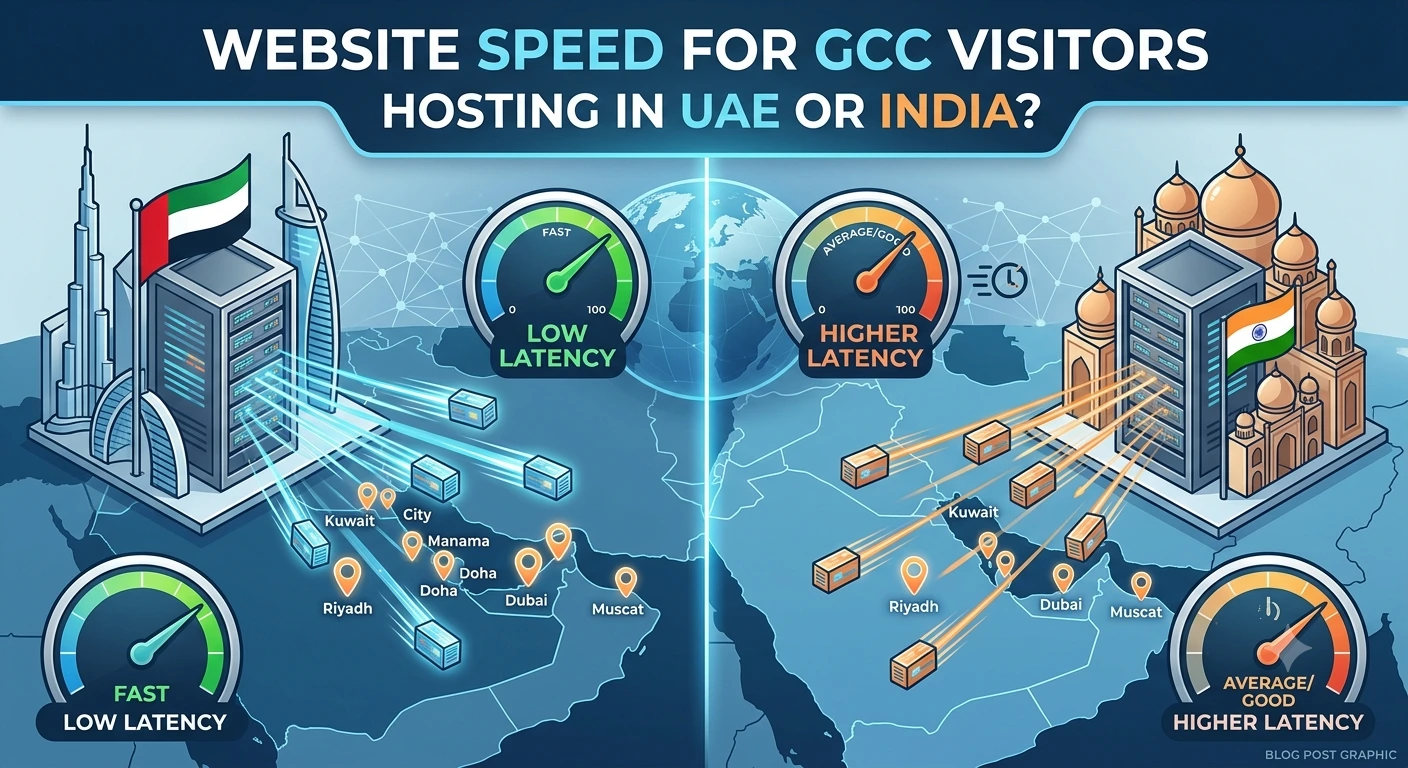
Website Speed for GCC Visitors: Hosting in UAE or India?
J
Jubairiya
Digital Marketing Executive
Jubairiya
Digital Marketing Executive
Where should you host a site for Gulf customers? How server location, CDN and Core Web Vitals affect speed, SEO and conversions.
You have a website for customers in Dubai, Riyadh or Doha. The developer is in Kerala, the hosting plan was cheapest in India, and the site "works fine" on your laptop. Then a customer in Jeddah opens it on mobile data, waits, and leaves. So where should you host a website that serves the Gulf: in the UAE (or another Gulf region), or in India? The short answer is that server location matters, but it is rarely the only thing slowing your site. This guide explains what hosting location actually changes, what a CDN fixes, which Core Web Vitals it touches, and how to choose for your business. IT company in Kerala for businesses across India and GCC
If most of your customers are in the GCC and your site is dynamic (online store, booking system, customer portal, logins), host in a Gulf region or put a CDN with Gulf servers in front of it. If your site is mostly static (a brochure site, a portfolio, a blog), hosting in India behind a good CDN can perform well and costs less. The mistake is not choosing India or the UAE. The mistake is choosing without checking where your visitors are, what your pages actually do, and how heavy they are.
Every page view starts with a request travelling from your visitor's phone to your server and back. The farther the server, the longer each round trip takes. That delay is called latency, and it is added to every request the page makes: the HTML, then scripts, styles, fonts and images. Two parts of this matter most for a GCC audience: • Time to First Byte (TTFB). How long the server takes to start responding. A distant server or a slow database pushes this up. • Dynamic requests. Product searches, cart updates, form submissions and logins must reach your server each time. A CDN cannot answer these from a nearby cache the way it can with an image. The Gulf has good mobile networks, so people expect pages to load quickly and may not wait. A slow first response is the part you cannot fix later with image compression.
A content delivery network (CDN) keeps copies of your static files, such as images, CSS and JavaScript, on edge servers around the world. With full-page caching switched on, it can also serve entire HTML pages from those edges. A visitor in Doha then receives most of the page from a nearby edge rather than from your origin. Two practical checks before you rely on one:
Google's Core Web Vitals measure real visitor experience. The published "good" thresholds are:
| Metric | What it measures | Good score |
|---|---|---|
| LCP (Largest Contentful Paint) | How fast the main content appears | 2.5 seconds or less |
| INP (Interaction to Next Paint) | How quickly the page reacts to taps and clicks | 200 ms or less |
| CLS (Cumulative Layout Shift) | How much the layout jumps while loading | 0.1 or less |
Hosting location has the clearest effect on LCP, because a slow server response delays everything that follows. It can influence INP on sites that wait for the server after every tap. It has almost no effect on CLS, which comes from images without dimensions, late-loading banners and fonts. This is why moving a heavy, badly built site to a UAE server often disappoints. If your homepage loads a 4 MB hero image and a dozen plugins, a closer server helps a little and the page is still slow. Check your real numbers in Google Search Console (Core Web Vitals report) and PageSpeed Insights before you spend money on a migration.
A CDN (content delivery network) keeps copies of your static files, such as images, CSS and JavaScript, on servers around the world and serves each visitor from a nearby one. Major CDN and cloud providers have points of presence in the Gulf, so a visitor in Dubai or Riyadh can often get static files from a regional server even if your origin is in India. A CDN helps with: • Faster image, script and style delivery • Handling traffic spikes during Ramadan offers, National Day sales or ad campaigns • An extra layer of protection against basic attacks A CDN does not fix: • Slow database queries or an overloaded server • Dynamic pages that cannot be cached, such as checkout and account areas • Oversized images and too many scripts (it delivers a heavy page faster, but the page is still heavy) A practical rule: a CDN narrows the gap between India and UAE hosting for static content. It does not remove the gap for dynamic content.
| Factor | Hosting in UAE / Gulf region | Hosting in India |
|---|---|---|
| Speed for GCC visitors | Shorter distance, lower latency | Longer distance; acceptable for static pages behind a CDN |
| Dynamic sites (shops, bookings, logins) | Usually the stronger choice | Can lag without caching or a regional origin |
| Cost | Often higher for the same server specification | Often lower |
| Support and billing | Depends on provider; local billing in AED or SAR may be available | Billing in INR; support hours overlap well with the Gulf |
| Data rules | May be easier if your sector expects data to stay in-country | Check your sector's requirements before storing customer data in India |
| Best for | Online stores, portals, booking and healthcare sites | Brochure sites, portfolios, blogs, early-stage projects |
The comparison is a guide, not a rule. Provider quality varies more than country does. A well-tuned server in India can beat a crowded shared plan in Dubai.
Choose a UAE or Gulf-region host when: • Your site takes orders, bookings or payments and speed affects revenue. Our ecommerce website cost guide for GCC sellers explains why store builds carry extra performance requirements. • Your audience is almost entirely in the GCC. • You work in a regulated sector such as healthcare, finance or government-linked work. Check the rules that apply to you first, and ask your legal or compliance contact if you are unsure. • You already have a local server partner and want everything under one contract.
Hosting in India is a reasonable choice when: • You run a marketing site, a portfolio or a blog and put a CDN in front of it. • Your visitors are spread across India, the Gulf and other regions. • You want predictable costs and a team in a nearby time zone. If you are weighing this up more broadly, read why GCC Malayali business owners outsource web development to Kerala. • You are early in your project and can move to a Gulf region later without a rebuild. If you are still comparing overall project costs between the two markets, see our website cost comparison for Dubai and Kerala. Hosting is only one line in that budget.
Before you migrate, work through this list. For many GCC sites, it delivers a bigger gain than changing the country of the server.
You do not need to guess. A simple test takes about thirty minutes:
For most GCC-facing business sites, a balanced setup works well: a well-built site, good hosting with enough resources, a CDN in front, and image and script optimisation. If the site takes payments or serves a Gulf-only audience, we look at a Gulf-region origin as well. We choose based on your audience and your pages, not on a default. If you want to see how we build and host sites for Gulf clients, browse our portfolio, or read how remote delivery works in our guide on hiring a Kerala agency without a UAE office. Our custom website development service covers performance planning from the start, so hosting decisions are made on data.
Not sure whether your hosting is the problem? Send us your website address. We will test it from a GCC visitor's point of view, show you where the time is going, and tell you honestly whether a move to UAE hosting is worth it or whether a simpler fix will do.

How CODO AI built the KUG Result Publication Portal in 3 months: Next.js, MySQL and a build made for result-day traffic spikes.
Compare WooCommerce, Shopify and custom builds for Gulf stores. See what each costs, how it handles Arabic and local payments, and which fits your stage.

How GCC online stores use an AI WhatsApp chatbot to answer product questions, recover abandoned carts and handle order status. Setup and cost.